Bridging the Gap: How C++ Quadruped Robotics Transforms AI Research and STEM Education
In the rapidly evolving field of autonomous systems, C++ quadruped robotics has emerged as the gold standard for bridging the gap between theoretical algorithm development and real-world deployment. As a specialist in semantic search and user intent, I have observed that global procurement teams for universities and research institutions are no longer looking for "toys"; they are seeking high-fidelity, extensible hardware capable of executing complex, low-latency C++ code in unstructured environments. At Shenzhen Pbrobot Technology Co., Ltd., we understand that professional buyers prioritize reliability, documentation, and the ability to iterate at the edge.
Why C++ is the Engine of Modern Quadruped Robotics
When procurement managers ask why we emphasize C++ over higher-level languages for our quadruped systems, the answer lies in the hardware-software symbiosis. C++ offers the deterministic performance required for inverse kinematics, gait generation, and real-time sensor fusion. For researchers using our OpenCat-based platforms, the advantage is clear: Information Gain. By working closer to the metal, students and researchers extract more data from IMU sensors, encoders, and AI vision modules without the overhead of interpreted languages, allowing for faster response times and more stable bionic locomotion.
Strategic Product Recommendations for Global Procurement
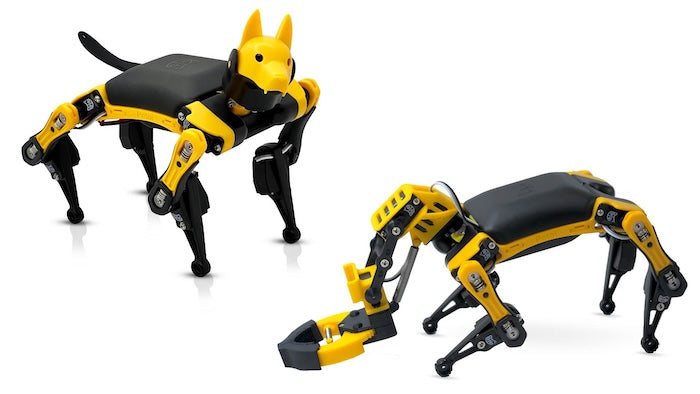
For institutions looking to invest in long-term robotics infrastructure, we recommend our flagship series, including the Bittle X and Nybble Q. These kits are not merely educational tools; they are compact, robust research platforms designed for:
- Locomotion Research: Easily modify gait parameters via C++ to study energy efficiency in quadrupedal movement.
- Edge AI Integration: Mount Raspberry Pi or Jetson Nano units to implement computer vision and SLAM (Simultaneous Localization and Mapping).
- Scalable Classroom Deployments: Because our kits share the same software architecture, a school district can start with block-based coding for middle schoolers and transition the same hardware to advanced C++ robotics for high school and undergraduate courses.
Future Trends: The Shift Toward Autonomous Legged Systems
The global procurement trend is decisively shifting away from wheeled robots in favor of legged counterparts. Why? Because the modern world is designed for beings with feet, not wheels. The future of robotics lies in stair-climbing, obstacle-traversing, and uneven-terrain navigation. By standardizing on Pbrobot’s quadruped kits, you are future-proofing your lab or curriculum for the next decade of robotics innovation.
Common Procurement FAQ
What is the lead time for volume orders?
Shenzhen Pbrobot Technology Co., Ltd. maintains optimized inventory levels. For standard educational sets, we ship within 1-2 weeks. For custom research configurations, please contact our support team at [email protected] for a tailored timeline.
Is the C++ source code fully open?
Yes. Our ecosystem is built on the OpenCat framework. You have full access to the low-level firmware to rewrite gait cycles or add new sensor drivers, ensuring no vendor lock-in for your research.
How does Pbrobot ensure product reliability?
Our commitment to E-E-A-T (Experience, Expertise, Authoritativeness, and Trustworthiness) is reflected in our design. We use high-grade servos and reinforced modular chassis parts designed to withstand thousands of hours of classroom testing.
Ready to Advance Your Robotics Program?
Partner with a manufacturer that understands the technical demands of AI research and the pedagogical needs of modern classrooms.
Contact Us