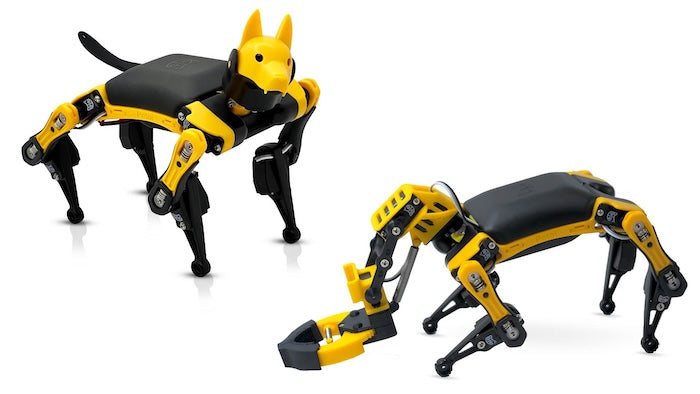
Bittle X Robot Dog
High-torque 9-DOF and 11-DOF ESP32 quadruped dog with integrated voice recognition and optional robotic arm manipulator.
BiBoard ESP32Voice CommandGripper ReadyOpenCat C++
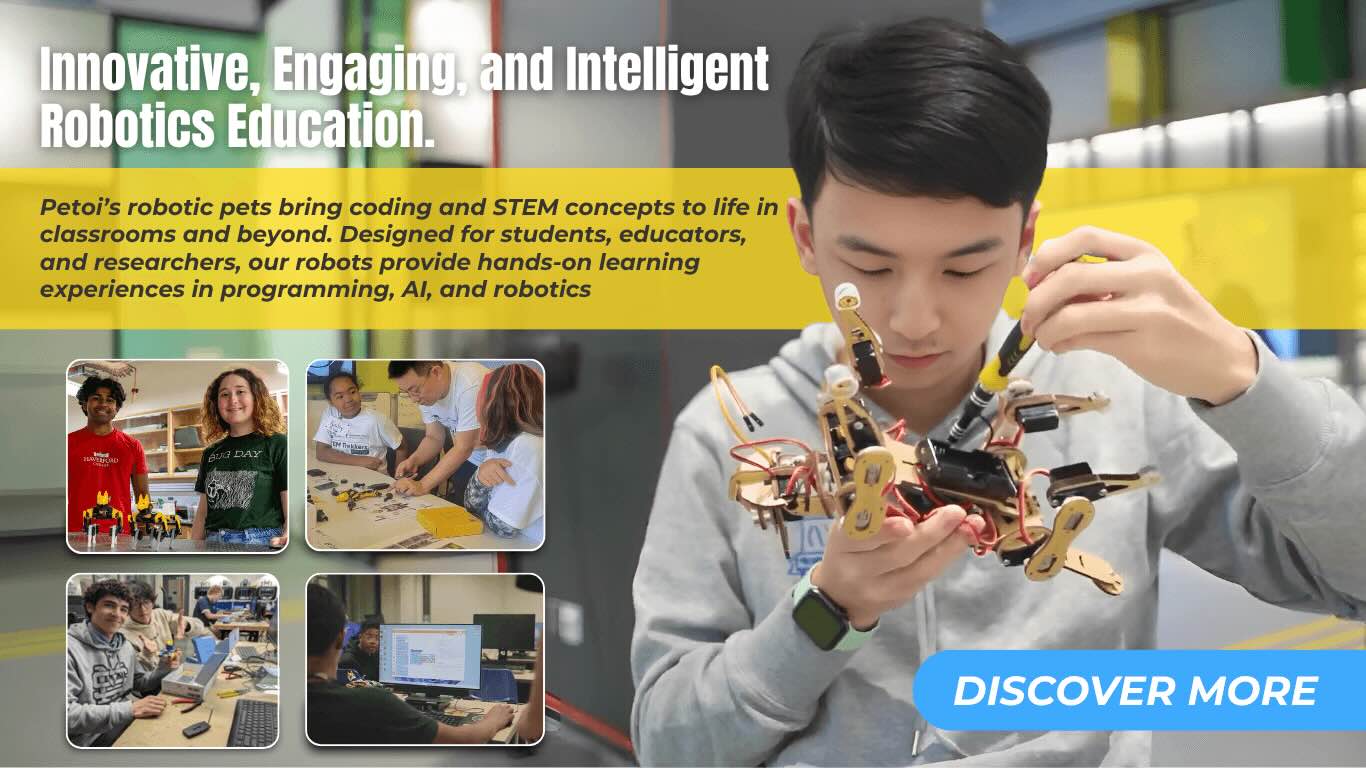
The definitive guide for procurement directors, university engineering labs, and STEM distributors evaluating high-performance 32-bit quadruped robotics.
Real-Time Legged Kinematics with BiBoard ESP32
High-bandwidth 16-channel servo coordination, 6-axis IMU attitude control, and offline voice intelligence.
OpenCat Platform: Bridging Microcontrollers & Neural Vision
Mount Raspberry Pi, NVIDIA Jetson, and vision cameras over high-speed hardware UART serial interfaces.
Validated by global robotics laboratories & technical engineering publications














Engineered by Shenzhen Pbrobot Technology Co., Ltd., our modular ESP32 quadrupeds integrate high-torque coreless digital servos, closed-loop IMU stabilization, and flexible peripheral interfaces for academic and commercial deployments.
High-torque 9-DOF and 11-DOF ESP32 quadruped dog with integrated voice recognition and optional robotic arm manipulator.
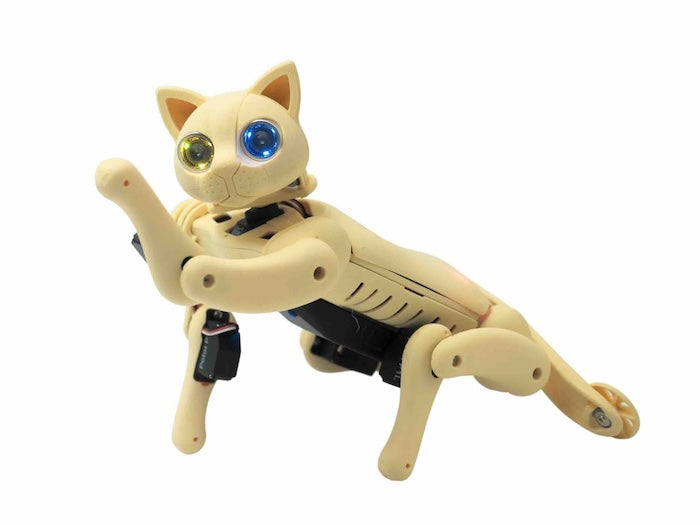
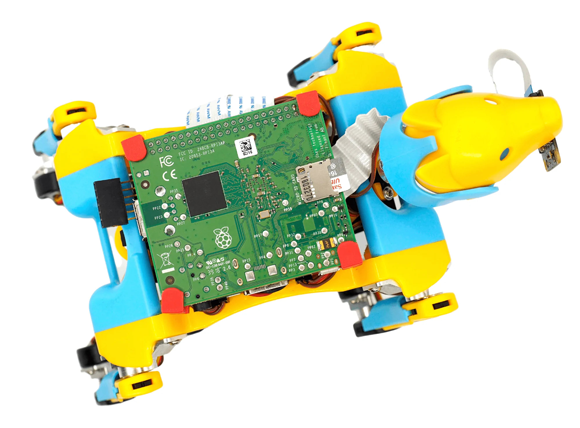
Ultra-agile 11-DOF feline form-factor powered by ESP32, tailored for biological gait studies, artificial life simulation, and edge AI vision.
Compact, highly customizable desktop quadruped kit designed for maker laboratories, embedded firmware engineers, and robotics prototyping.
The pioneer OpenCat quadruped robot dog built on the ATmega328P NyBoard architecture, ideal for basic microcontroller instruction.
As enterprise education, defense simulation, and industrial inspection programs evolve, institutional procurement directors are prioritizing several strategic shifts in legged robotics sourcing.
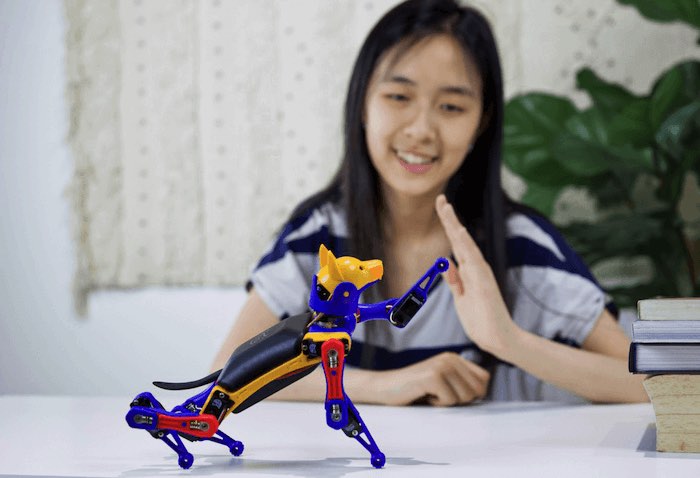
Procurement departments are diversifying away from bulky, 40kg industrial quadrupeds that require reinforced safety enclosures, specialized charging bays, and six-figure budgets.
Modern engineering faculties deploy desktop-class ESP32 quadruped robots at scale. A single capital budget allocation of $50,000 can outfit an entire department with over 150 Bittle X units, delivering direct 1-to-1 hands-on research opportunities instead of forcing 30 students to observe a single industrial unit from behind security glass.
Procurement specifications are shifting toward hybrid edge-compute topologies separating real-time kinematic pulse generation from cognitive computing.
The ESP32 microcontroller serves as the deterministic low-level real-time motion controller, guaranteeing jitter-free PWM pulse generation at 50Hz–333Hz, reading 6-axis IMU balance feedback at 200Hz, and executing fast reflex protection. Simultaneously, companion single-board computers (Raspberry Pi 4B/5 or NVIDIA Jetson Nano/Orin) handle heavy ROS 2 navigation nodes, simultaneous localization and mapping (SLAM), and computer vision pipelines via high-speed serial UART buses.
Procurement committees increasingly reject closed-source proprietary platforms that impose recurrent software subscription licenses and lock universities out of lower firmware layers.
Shenzhen Pbrobot Technology Co., Ltd. builds exclusively upon the globally renowned OpenCat open-source framework. Institutional buyers retain complete auditability, academic freedom to rewrite gait kinematics, compile custom firmware variants, and implement bleeding-edge reinforcement learning models using PyTorch and Isaac Gym without vendor authorization barriers.
Get a QuoteUnderstanding how semiconductor innovation, embedded algorithms, and battery technology are elevating the capabilities of palm-sized bionic quadrupeds.
The arrival of ESP32-S3 and RISC-V variants introduces dedicated vector instructions, enabling on-chip TinyML neural network inference for real-time acoustic scene analysis and micro-gesture recognition without coprocessors.
Transitioning from traditional 50Hz analog PWM lines to high-speed UART half-duplex daisy-chained serial bus servos. This unlocks bidirectional telemetry including real-time joint angular feedback, winding temperature, and torque profiling.
Deploying deep reinforcement learning policies trained in NVIDIA Isaac Gym or MuJoCo physics environments directly into C++ look-up tables on the ESP32, achieving robust biological recovery across compliant surfaces.
Advanced 2S Li-ion battery cartridges featuring integrated I2C fuel gauge ICs, cell balancing, and short-circuit thermal management guarantee continuous 45+ minute mission endurance under heavy dynamic gaits.
Detailed performance benchmarks to assist institutional sourcing specialists in selecting the optimal quadruped robotics configuration.
| Evaluation Metric | Bittle X (ESP32 Flagship) | Nybble Q (ESP32 Bionic Cat) | Bittle Classic (AVR 8-Bit) | Generic DIY Open Quadruped |
|---|---|---|---|---|
| Microcontroller Core | Espressif ESP32 Dual-Core (240MHz) | Espressif ESP32 Dual-Core (240MHz) | ATmega328P (16MHz 8-Bit) | STM32F103 / ESP8266 (Single-Core) |
| Degrees of Freedom (DOF) | 9 to 11 DOF (Arm Gripper Ready) | 11 DOF (Bionic Cat Spine & Tail) | 9 DOF (Basic Quadruped) | 8 DOF (Basic Walk Only) |
| Kinematic Execution | Hardware FPU Real-Time Inverse Kinematics | Hardware FPU Real-Time Inverse Kinematics | Pre-baked EEPROM Static Keyframes | Basic Sine Wave Approximation |
| Wireless Protocol Stack | Native Bluetooth 4.2 BLE + 2.4GHz Wi-Fi | Native Bluetooth 4.2 BLE + 2.4GHz Wi-Fi | External Bluetooth/Wi-Fi Dongles | Varies / Often Uncertified Modules |
| Voice Processing Engine | Real-time Offline Neural Voice Recognition | Add-on Voice Expansion Module | Not Supported (Memory Constrained) | Cloud-Dependent Only |
| SBC Co-Processor Mount | Direct Raspberry Pi 3A+/Zero / Jetson (UART) | Direct Raspberry Pi Zero / Camera Module | Serial UART (Constrained Buffer) | Custom Bracket Fabrication Required |
| Structural Material | High-Impact Injection-Molded ABS/PC | Precision Laser-Cut Composite Wood/ABS | High-Impact Injection-Molded ABS | Fragile 3D Printed PLA (Low Impact) |
| Certification & Compliance | CE, FCC, RoHS 2.0, REACH, UN38.3 | CE, FCC, RoHS 2.0, REACH, UN38.3 | CE, FCC, RoHS 2.0 | Non-certified Components |
Certified data confirmed by Shenzhen Pbrobot Technology Co., Ltd. laboratory inspection standards.
Pioneering agile bionic robotics since 2018. Over 20,000 quadruped units delivered to universities, secondary schools, AI research laboratories, and authorized global educational distributors across 50+ countries.
Get a QuoteAs the original creators of Bittle, Nybble, and the OpenCat robotics framework, we combine tier-one Chinese manufacturing agility with international engineering rigor.
Shenzhen Pbrobot Technology Co., Ltd. holds complete intellectual property over the OpenCat framework. Unlike repackagers, our firmware engineers build directly from the bare-metal register level up.
We supply turnkey educational frameworks: step-by-step block-based coding (Scratch), embedded C++ kinematics courses, and advanced Python/ROS 2 documentation that save institutions hundreds of curriculum design hours.
Our quadrupeds utilize precision high-pressure injection molding for high tensile yield strength and tight assembly tolerances, eliminating joint backlash and chassis flexing inherent in 3D-printed toys.
Full support for enterprise purchase orders, Incoterms (EXW, FOB, DAP, DDP), institutional net payment terms, CE/FCC documentation, and hazardous materials air transit safety compliance.
Direct technical and commercial answers addressing common inquiries from educational directors, supply chain managers, and lab coordinators.
The ESP32 microcontroller features dual Xtensa 32-bit LX6 cores operating at up to 240 MHz with built-in hardware floating-point units (FPU). Unlike legacy 8-bit AVR microcontrollers constrained by 16 MHz clock speeds and lack of native floating-point math, the ESP32 calculates 16-channel inverse kinematics, gait cycle trajectories, and sensor fusion matrices in real time with sub-millisecond latency. Additionally, the ESP32 provides native 2.4 GHz Wi-Fi and dual-mode Bluetooth (Classic + BLE) directly on-chip, enabling remote command streaming and telemetry without requiring external transceiver boards.
In the Petoi BiBoard ESP32 architecture developed by Shenzhen Pbrobot Technology Co., Ltd., task execution is partitioned across FreeRTOS cores. Core 0 is dedicated to high-speed digital PWM pulse generation, real-time closed-loop IMU balance stabilization, and hardware servo safety boundaries. Core 1 handles network stacks, Wi-Fi telemetry, REST/WebSocket command parsing, Bluetooth serial transport, and real-time offline neural voice recognition. This dual-core layout prevents high-latency wireless packets from interrupting high-speed servo gait timing.
Operating 9 to 11 high-torque coreless servos simultaneously induces transient current spikes exceeding 4.5A during aggressive dynamic maneuvers (such as backflips or obstacle climbing). To ensure stability, Petoi ESP32 boards feature separated logical and mechanical power rails, onboard buck-boost regulators, 7.4V dual-cell Li-ion balancing circuitry, and low-dropout logic filters to prevent microsecond brownout resets during peak loads.
Yes. The ESP32 quadruped robot serves as an agile real-time kinematic motion controller. Higher-tier compute modules such as the Raspberry Pi 4B/5, CM4, or NVIDIA Jetson Orin Nano communicate with the ESP32 board over high-speed hardware UART serial interfaces at 115200 or 921600 baud, transmitting linear/angular velocity twist messages and receiving IMU odometry data. The host Linux SBC runs standard ROS 2 navigation packages, vision-based SLAM, and OpenCV pipelines without overburdening the real-time microcontroller.
Modular quadruped platforms like Bittle X reduce deployment capital expenditure by over 80% compared to heavy enterprise robotic dogs. Modular injection-molded snap-in components, quick-swap digital metal-gear servos, field-replaceable 7.4V battery cartridges, and open firmware allow academic labs to sustain multi-year laboratory curriculums with negligible maintenance downtime. If a joint servo wears out after hundreds of hours of testing, it can be replaced in five minutes with standard screwdrivers.
Shenzhen Pbrobot Technology Co., Ltd. provides comprehensive compliance dossiers for global customs clearance, including CE (EMC & RED), FCC Part 15B/15C, RoHS 2.0 directive compliance, REACH certifications, and UN38.3 battery transport safety documentation with MSDS reports. Institutional procurement packages are insured and eligible for door-to-door Delivered Duty Paid (DDP) freight arrangements.
Turnkey instructional resources created to accelerate classroom adoption and maximize research grant return on investment.
Scratch-compatible visual drag-and-drop programming covering sensor triggers, sequence logic, and gait design.
Explore Curriculum High School & UniversityReal-time kinematics, trigonometric joint trajectories, and low-level FreeRTOS firmware modification on the ESP32.
Explore Curriculum Research & Post-GradComprehensive Python API bindings, high-speed serial UART command pipelines, and teleoperation drivers.
Explore Documentation Makerspace & PrototypingParametric CAD models and open STL files allowing mechanical engineering students to design custom limbs and chassis mounts.
Explore CAD ModelsEvaluations from engineering professors, robotics instructors, and laboratory researchers using Petoi robots worldwide.
Connecting institutions directly with Shenzhen Pbrobot Technology Co., Ltd. Submit your lab specifications, required unit volumes, and destination country to receive immediate tiered commercial pricing, compliance dossiers, and formal proforma quotations.
[email protected]