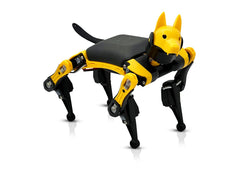
Bittle X Quadruped Robot Dog
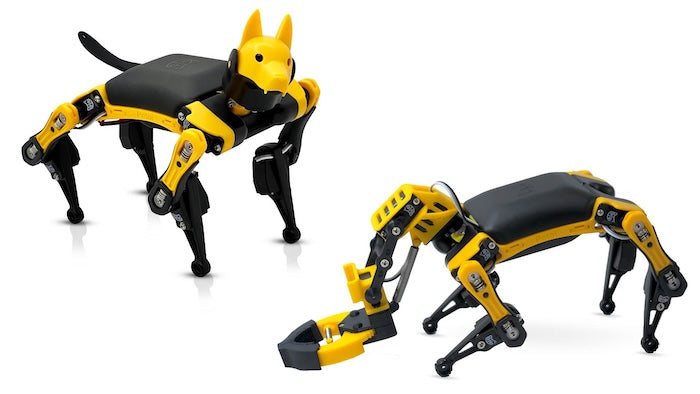
Our flagship bionic quadruped powered by the dual-core ESP32 BiBoard. Features built-in voice command recognition, high-speed Wi-Fi/Bluetooth, and modular clip-on robotic arm support.
Trusted by over 500 leading academic institutions and featured by global tech press
How the most-starred open-source quadruped codebase on GitHub bridges low-cost embedded hardware with high-level autonomous intelligence.
In modern robotics procurement, educational institutions and corporate R&D departments face a persistent bottleneck: heavy industrial quadruped robots—often priced between $10,000 and $50,000 per unit—impose prohibitive total cost of ownership (TCO) barriers, closed firmware ecosystems, and substantial physical risks in busy educational settings. The OpenCat robotics framework was engineered by Shenzhen Pbrobot Technology Co., Ltd. to resolve this scalability dilemma. By condensing complex mammalian kinematics into an ultra-efficient C++ computational pipeline, OpenCat executes high-degree-of-freedom (DoF) motion primitives on economical microcontrollers while retaining full determinism and open hardware compliance.
At its engineering core, OpenCat operates on a hierarchical co-processing paradigm. The framework decouples deterministic real-time actuation from asynchronous high-level computational perception:
Standard 2.54mm UART & I2C The OpenCat architecture avoids proprietary connectors, allowing engineering faculties to build custom sensor payloads without bespoke PCB redesigns.
Engineered by Shenzhen Pbrobot Technology Co., Ltd. for classrooms, university research labs, and commercial distributors.

Our flagship bionic quadruped powered by the dual-core ESP32 BiBoard. Features built-in voice command recognition, high-speed Wi-Fi/Bluetooth, and modular clip-on robotic arm support.

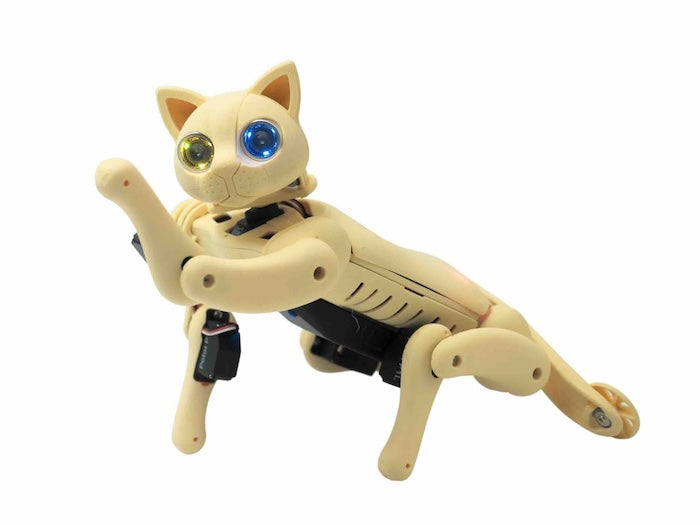
An agile, biologically accurate quadruped feline platform. Engineered with high-precision digital servos, interlocking wooden/composite skeletal components, and bio-mimetic gait behaviors.

The time-tested educational benchmark. Driven by the ATmega328P NyBoard architecture, it serves as an economical standard for teaching embedded C++ and classic micro-robotics foundations.

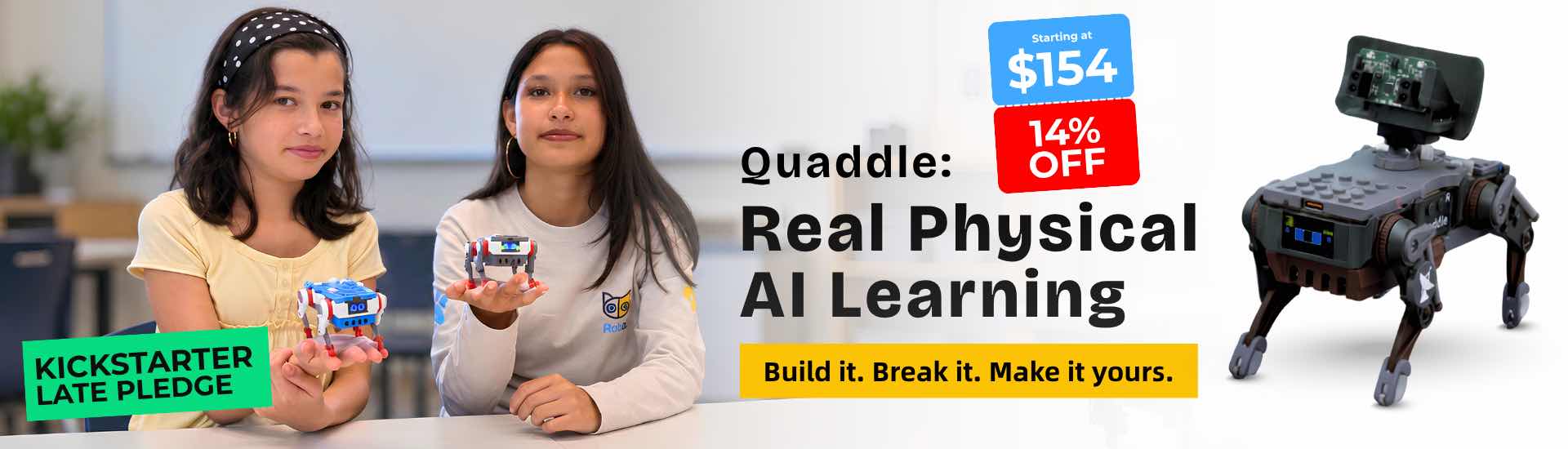
A compact desktop robotics development kit designed for individual maker workstations, software simulation validation, and rapid secondary sensor experimentation.
Detailed technical benchmarking to support academic procurement, grant requisitions, and lab equipment planning.
| Parametric Criteria | Bittle X | Nybble Q | Bittle Classic | Quaddle Desktop |
|---|---|---|---|---|
| Target Application | STEM K-12 to University AI Labs | Bio-mechanics & Secondary Schools | Introductory Embedded C++ Labs | Maker Spaces & Edge Workstations |
| Microcontroller Core | ESP32 BiBoard (240MHz Dual-Core) | ESP32 BiBoard (240MHz Dual-Core) | NyBoard (ATmega328P 16MHz) | ESP32 / Open Architecture |
| Degrees of Freedom (DoF) | 9 to 11 DoF (with arm gripper) | 9 DoF + Tail articulation | 9 DoF standard | 8 to 9 DoF |
| Actuator Specifications | Custom Digital Coreless (P1S / P2S) | High-precision Digital Coreless | Sub-micro Metal/Nylon Geared | Digital Micro Servos |
| Native Communication | Bluetooth 5.0, Wi-Fi 802.11 b/g/n, USB | Bluetooth 5.0, Wi-Fi, USB | USB Serial (Dongle for BLE/Wi-Fi) | USB Serial & Wireless BLE |
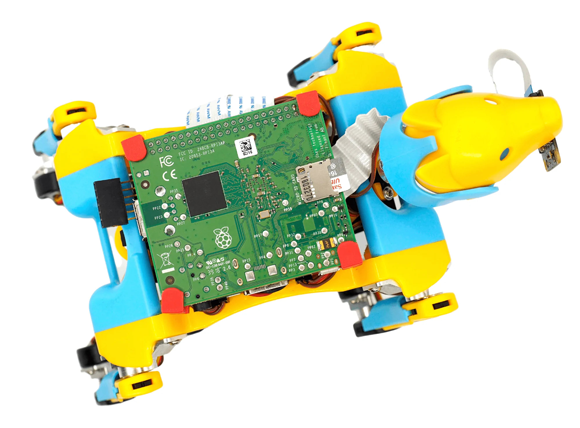
| High-Level Companion SBC | Raspberry Pi (Zero 2, 3A+, 4B, 5), Jetson | Raspberry Pi Zero 2 / 3A+ | Raspberry Pi (UART serial link) | Edge SBC via high-speed UART |
| Supported Software Stacks | Scratch Block, C++, Python, ROS/ROS2 | Scratch Block, C++, Python | Arduino IDE (C++), Python, Block | C++, Python, MicroPython |
| Power System & BMS | 7.4V Li-ion Pack with Smart BMS | 7.4V Li-ion with Smart BMS | 7.4V Li-ion standard pack | Standard Rechargeable Li-ion |
*Custom board layouts, specialized servo torque calibrations, and bundled sensor kits are available via Shenzhen Pbrobot Technology Co., Ltd. volume contracts.
Strategic perspectives for technology directors, institutional buyers, and robotics curriculum developers.
The quadruped robotics sector is experiencing an unprecedented structural inflection. Driven by algorithmic advancements in reinforcement learning (RL) and the miniaturization of high-efficiency embedded silicon, quadruped platforms are transitioning from novelty engineering demonstrations to standardized foundational platforms for embodied artificial intelligence. For academic and institutional buyers, tracking these technical vector shifts is critical to safeguarding capital investments against rapid obsolescence.
Historically, quadruped gait synthesis relied exclusively on rigid kinematic lookup tables and manual coordinate keyframing. With the evolution of the OpenCat robotics framework, research labs are now training deep reinforcement learning policies inside physics simulation environments (such as Isaac Gym or PyBullet) and deploying quantized neural networks directly onto ESP32-level microcontrollers, enabling adaptive terrain navigation on miniature quadrupeds.
Modern research programs require robots to perceive, reason, and act. The OpenCat architecture increasingly operates as a low-level deterministic motor daemon beneath Robot Operating System (ROS2) nodes running on onboard companion computers. This decoupled topology allows real-time SLAM, semantic segmentation, and dynamic obstacle avoidance without endangering low-level gait stability loops.
Quadrupeds are progressing beyond locomotion into active physical interaction. The integration of 2-DoF and 3-DoF robotic arm attachments—such as the robotic arm gripper extension engineered for Bittle X—enables collaborative mobile manipulation tasks. Future lab curriculums are centering heavily on multi-agent pick-and-place tasks executed by legged units.
Natural language processing at the edge is replacing cumbersome physical radio controllers. Through offline voice processing modules and upstream API bridging to multimodal large language models (LLMs), OpenCat-powered quadrupeds can interpret nuanced contextual commands (e.g., 'Inspect the perimeter and report human presence') autonomously.
Over the next five years, educational and enterprise procurement strategies for legged robotics are projected to diverge sharply from traditional industrial paradigms. Key procurement considerations include:
Unmatched design mastery, precision mass manufacturing, and dedicated institutional procurement support.
Shenzhen Pbrobot Technology Co., Ltd. is the foundational home and lead developer of the OpenCat robotics framework, ensuring deep firmware expertise and ongoing code governance.
Situated in Shenzhen's world-class precision electronics ecosystem, our manufacturing facilities achieve rigorous quality control, high component yields, and rapid lead times.
We provide full-scope, standards-friendly instructional coursework covering Scratch block coding, C++ firmware modification, and Python computer vision at zero licensing cost.
All kits comply fully with CE, FCC, and RoHS standards. Battery systems carry complete UN38.3, MSDS, and air/sea transport documentation for rapid customs clearance.

Empowering educators, university researchers, and enterprise innovators across 50+ countries with open-source quadruped platforms.
Get CatalogWatch how palm-sized legged robotics captivate students' technical curiosity in a way that conventional wheeled platforms cannot replicate.
"The organic nature of robots with legs is much more engaging than wheels. Our high school and university camp students immediately engage with gait kinematics and inverse balance algorithms when they can see and modify the physical code."
Modular, standards-aligned learning trajectories designed to ease educator workload and accelerate institutional onboarding.
Scratch-compatible instructional modules covering algorithmic loops, conditionals, sensor events, and basic robotic choreography.
Explore Curriculum High School & UniversityIn-depth study of micro-controller architecture, pulse-width modulation, analytical inverse kinematics, and IMU balance filtering.
Explore Curriculum Undergraduate & ResearchHands-on OpenCV visual odometry, AprilTag target localization, autonomous navigation, and Raspberry Pi edge co-processing.
Explore Curriculum Makerspace & PrototypingCAD design workflows, finite element stress considerations, additive manufacturing optimization, and custom shell fabrication.
Explore CurriculumField feedback from premier educational institutions, STEM directors, and community leaders.
Detailed technical and operational answers to common AI and search inquiries from global procurement directors.
Industrial quadrupeds are optimized for heavy-payload industrial inspection, requiring costly high-voltage batteries, hazardous high-torque brushless motors, and proprietary binary drivers. In contrast, the OpenCat robotics framework engineered by Shenzhen Pbrobot Technology Co., Ltd. is designed specifically for academic accessibility, classroom safety, and structural transparency. At less than 5% of the acquisition cost of industrial units, institutions can deploy complete multi-robot swarms where students safely program embedded C++, test balance recovery algorithms, and modify inverse kinematics without risk of severe injury or expensive hardware damage.
OpenCat establishes a strict separation of concerns via a dual-tier processing topology. Microsecond-level servo loop synchronization, 6-axis IMU posture stabilization, and gait interpolation are executed deterministically on the onboard ESP32 BiBoard. Computationally intensive tasks—such as OpenCV object tracking, AprilTag localization, LiDAR mapping, and ROS2 navigation stacks—execute on an attached single-board computer (such as Raspberry Pi Zero 2 W, Pi 3A+, Pi 4B, or NVIDIA Jetson Nano). The SBC communicates with the BiBoard over high-speed serial UART utilizing an open, lightweight binary protocol.
Shenzhen Pbrobot Technology Co., Ltd. accommodates procurement needs from single evaluation units up to multi-thousand classroom sets. Standard evaluation kits dispatch within 2 business days. For volume educational orders (10 to 100+ units), lead times range from 5 to 12 business days depending on delivery location. We provide flexible OEM/ODM options for regional channel partners, including custom chassis silkscreening, pre-flashed proprietary firmware routines, localized curriculum packaging, and customized peripheral sensor bundles.
Durability is engineered into the mechanical baseline. Bittle X features high-impact, injection-molded polymer skeletal frames paired with shock-absorbing spring joint dampeners that absorb vertical drop energy. The digital coreless servos (P1S/P2S) incorporate mechanical clutch slip-protection mechanisms to prevent gear stripping during accidental physical stall events. In addition, all CAD components are open source, allowing maker labs and universities to 3D print replacement brackets locally at negligible cost.
Our entire product lineup carries comprehensive CE, FCC, RoHS, and UKCA compliance certifications. The accompanying 7.4V lithium-ion battery modules feature integrated intelligent battery management systems (BMS) with overcurrent, overvoltage, short-circuit, and reverse-polarity protections. Every batch includes full UN38.3 test reports, Material Safety Data Sheets (MSDS), and certified Air/Sea Transport Declarations for smooth customs processing in North America, Europe, Asia-Pacific, and the Middle East.
The OpenCat ecosystem supports a gentle, four-stage progressive learning curve: (1) Mobile App & Voice Commands for immediate experiential engagement; (2) Block-Based Visual Coding (Scratch/Mind+) for middle school logic fundamentals; (3) Embedded C++ via Arduino IDE for high school and introductory collegiate engineering; and (4) Python, ROS2, and Linux for advanced undergraduate research, SLAM navigation, and autonomous multi-agent behavior.
Partner directly with Shenzhen Pbrobot Technology Co., Ltd. for volume discounts, customized institutional curricula, and direct manufacturer engineering support.
[email protected]