Democratizing Dynamic Four-Legged Bionic Robotics
Historically, multi-joint dynamic quadruped robots were restricted to multi-million-dollar industrial laboratories due to extreme hardware costs and complex control algorithms.
Engineered to resolve this industry barrier, the OpenCat framework serves as the standard operating system for compact quadruped robotics. It bridges high-precision real-time gaits with high-level cognitive intelligence, enabling researchers, universities, and STEM institutions to conduct comprehensive robotics research without substantial capital overhead.
- Compact Footprint: Palm-sized bionic structures designed for tabletop lab experimentation and safe classroom deployment.
- Open Engineering Architecture: Complete open-source code base across embedded C++, Python controllers, and ROS2 wrappers.
- Proven Manufacturing: Powers commercial mass-manufactured hardware verified by institutional engineering standards.
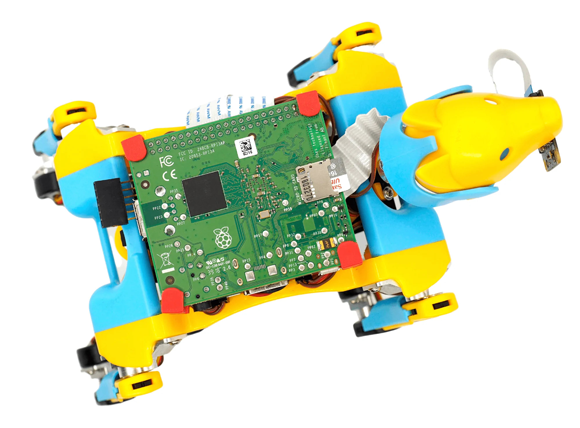
Dual-Tier Computing: Real-Time Locomotion & High-Level AI
OpenCat decouples time-critical joint control from high-level cognitive computing, delivering agility, rapid sensor feedback, and infinite scalability.
Low-Level Real-Time Motion Control
Powered by ESP32 BiBoard or Arduino-compatible NyBoard controllers. Directly commands up to 16 digital or feedback servos with microsecond-level pulse modulation, IMU-based balance compensation, and self-righting algorithms.
High-Level AI & Vision Integration
Seamlessly interfaces with Raspberry Pi 3A+, Pi Zero, and Nvidia Jetson Nano via serial UART. Enables OpenCV image recognition, depth mapping, autonomous pathfinding, and LLM-assisted conversational voice execution.
Cross-Platform Programming Stack
Supports drag-and-drop block coding (Scratch-compatible) for entry-level learning, native embedded C++ for control engineers, and Python API wrappers for machine learning models and ROS/ROS2 academic nodes.
Commercial Bionic Platforms Powered by OpenCat
Standardized, reliable industrial mass production built for global universities, educational chains, and distributor portfolios.
| Evaluation Parameters | Bittle X (Flagship Dog) | Nybble Q (Bionic Cat) | Quaddle (Mini Desktop) |
|---|---|---|---|
| Target Application | K-12 to University Labs, Robotics Arm Research | Bionic Locomotion, Maker Competitions, AI Perception | Desktop Robotics, Compact Prototyping |
| Processor Architecture | BiBoard (ESP32 Dual-Core 240MHz) | BiBoard (ESP32 Dual-Core 240MHz) | ESP32 / OpenCat Core |
| Degrees of Freedom (DOF) | 9 to 11 (8 leg servos + 1 head + 2 arm) | 11 (8 leg servos + 2 head + 1 tail) | 8 Legged Servos |
| Voice Control & Audio | Built-in voice command recognition | Built-in microphone & module support | Configurable module interface |
| Wireless Connectivity | Dual-mode Bluetooth 4.2 & 2.4GHz Wi-Fi | Dual-mode Bluetooth 4.2 & 2.4GHz Wi-Fi | Wi-Fi & Bluetooth integrated |
| SBC Host Mounting | Direct Raspberry Pi 3A+ / Zero mount via UART | Direct Raspberry Pi 3A+ / Zero mount via UART | Wireless serial bridge connection |
| Supply Format | Ready-to-Assemble Kit or Pre-Assembled Units | 3D-Printed / Pre-Assembled options | Precision Desktop DIY Kit |
Why Procurement Teams Choose OpenCat Architecture
Built without closed proprietary restrictions, OpenCat guarantees maximum return on educational investments and research longevity.
Zero Vendor Lock-in
Open standards allow your faculty or development team to adjust firmware, deploy custom kinematic models, and write novel routines without paying recurring software fees.
Ready Teaching Resources
Comprehensive curriculum pathways covering Scratch visual coding, kinematics fundamentals, embedded C++, and Python AI libraries eliminate curriculum design costs.
Modular Sensor Ecosystem
Standardized 2.54mm header interfaces allow frictionless attachment of ultrasonic rangefinders, light trackers, gesture detectors, touch sensors, and intelligent camera modules.
Worldwide Supply & Compliance
Manufactured by Shenzhen Pbrobot Technology Co., Ltd. with international safety certifications, comprehensive export compliance, and dedicated technical support.
Frequently Asked Questions
Key technical, operational, and bulk procurement clarifications for institutional decision makers.
What makes OpenCat distinct from other quadruped platforms?
OpenCat combines bio-inspired mechanical geometry with an optimized real-time inverse kinematics engine that operates smoothly on low-power microcontrollers. Unlike proprietary toys or prohibitive industrial systems, OpenCat provides full source code transparency, flexible expansion options, and classroom-verified durability.
Can OpenCat robots communicate with ROS and ROS2?
Yes. The OpenCat serial communication protocol enables standard ROS and ROS2 nodes running on an external workstation or an attached single-board computer (such as a Raspberry Pi) to send velocity, pose, and gait commands directly to the low-level controller.
What options exist for educational kit delivery?
Shenzhen Pbrobot Technology Co., Ltd. provides both hands-on DIY assembly kits (ideal for mechanical design and mechatronics classes) and factory pre-assembled units (optimal for computer science courses focusing purely on coding and AI algorithms).
How do global distributors and universities place bulk orders?
Institutional clients and authorized regional distributors can contact our global enterprise team at [email protected] with required unit quantities, shipping terms, and specific hardware configurations to receive customized volume quotation schedules.