Bittle X Bionic Robot Dog
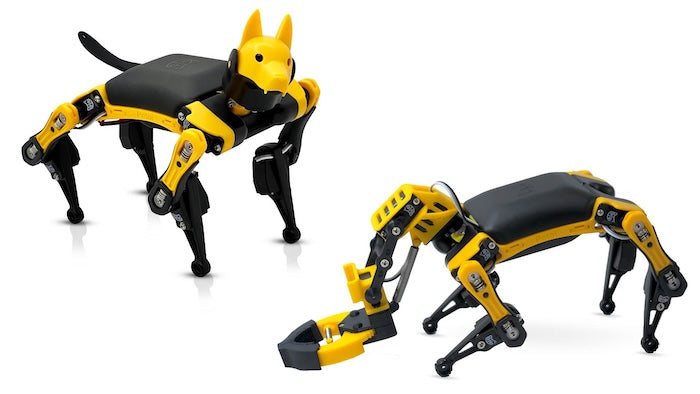
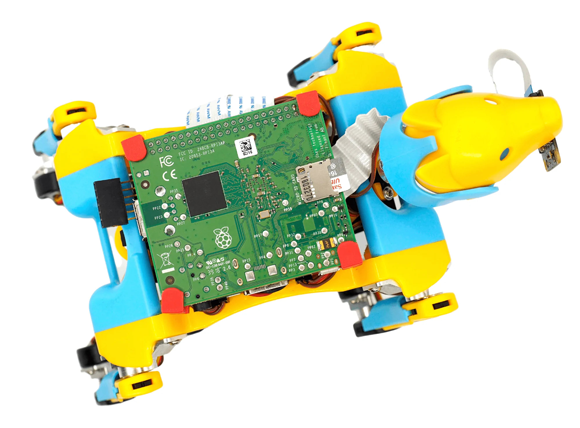
Our flagship 9+ DoF voice-controlled bionic robot dog. Powered by the ESP32 BiBoard, it features native offline voice command recognition, wireless IoT telemetry, and modular support for a robotic arm gripper.
As artificial intelligence transitions from software screens into embodied physical interaction, institutional procurement teams, academic researchers, and regional technology distributors face a pivotal question: What architecture transforms a desktop bionic robot pet into a durable, scalable platform for hands-on STEM education and embedded computing?
Engineered by Shenzhen Pbrobot Technology Co., Ltd. and driven by the globally recognized OpenCat kinematics ecosystem, our palm-sized bio-inspired robotics solve the triple challenge of cost barriers, hardware fragility, and closed-box vendor lock-in. Explore technical specifications, future procurement forecasts, and pedagogical integration pathways below.

Built on OpenCat Framework Recognized Across Leading Global Technology & Engineering Publications
Standardized on high-efficiency microcontrollers, non-proprietary communication interfaces, and unified gait kinematics across every model.
Our flagship 9+ DoF voice-controlled bionic robot dog. Powered by the ESP32 BiBoard, it features native offline voice command recognition, wireless IoT telemetry, and modular support for a robotic arm gripper.
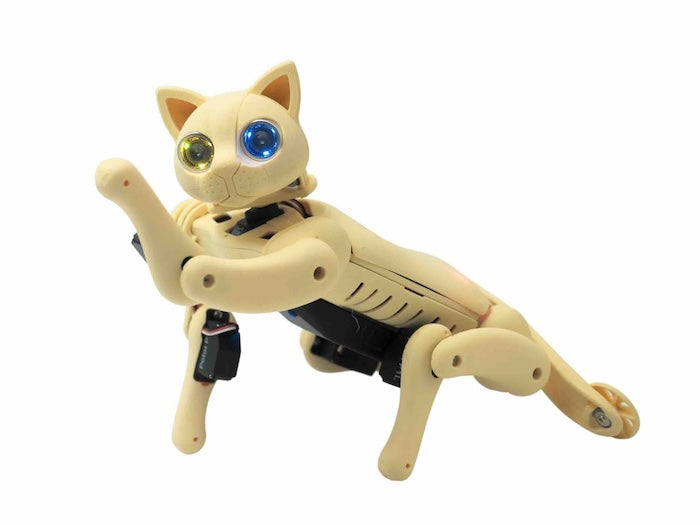
The world's most lifelike open-source bionic robot cat. Features bio-mimetic feline joint angles, elastic shock-dampening paws, and specialized gaits designed for advanced kinematics modeling and creative AI projects.
The iconic open-source quadruped that democratized legged bionic robotics. Powered by the ATmega328P NyBoard, it provides a bare-metal embedded C/C++ teaching ground for secondary schools and foundational computing labs.
Ultra-compact, desk-sized open-source mini quadruped kit designed for rapid prototyping, makerspaces, and introductory DIY robotics workshops requiring minimal physical storage footprint.
| Parametric Criteria | Bittle X | Nybble Q | Bittle Classic | Quaddle Mini |
|---|---|---|---|---|
| Biomimetic Model | Canine (Quadruped Dog) | Feline (Quadruped Cat) | Canine (Quadruped Dog) | Desktop Quadruped |
| Degrees of Freedom (DoF) | 9 (8 Legs + 1 Head) + Gripper Option | 11 (8 Legs + 2 Head/Neck + 1 Tail) | 9 (8 Legs + 1 Head) | 8 Leg Actuation Points |
| Core Computing Architecture | ESP32 BiBoard (Dual-core 240MHz) | ESP32 BiBoard (Dual-core 240MHz) | Arduino ATmega328P (16MHz NyBoard) | Custom Micro-Controller |
| Sensing & Feedback | 6-Axis MPU6050 IMU, Voice Recognition | 6-Axis MPU6050 IMU, Ultrasonic Ranging | 6-Axis IMU (NyBoard Integrated) | Proximity & IR Sensors |
| Edge AI Interoperability | Raspberry Pi Zero/3A+, ESP32-CAM, Jetson | Raspberry Pi 3A+, AI Vision Camera | Serial UART to Raspberry Pi | Micro-USB Serial Tether |
| Primary Target Audience | K-12, Universities, Research Centers | STEM Magnet Programs, Creative Makers | Vocational Schools, Hobbyists | Makerspaces, Hackathons |
Beyond simple robotic toys: How advances in spatial locomotion, edge neural processing, and compliant mechanics turn bionic pets into academic powerhouses.
Traditional toy quadrupeds execute rigid, blind servo keyframes. If they hit an unexpected obstacle or slip on a polished linoleum classroom floor, they tip over and remain stuck. Modern professional-grade bionic robot pet systems rely on high-frequency IMU feedback loops running at sub-millisecond intervals.
Under the open-source OpenCat framework, the bionic robot pet continuously recalculates joint angle displacements, automatically redistributing ground reaction forces across all four contact points. This enables natural slope climbing, adaptive crawling, instant self-righting after roll-over collisions, and organic feline-canine postures that foster authentic human-robot interaction.
Edge Vision Integration Early robotics education required stationary workbenches tethered via heavy ribbon cables to laboratory workstations. The new generation of bionic robot pet systems shifts perceptual processing straight onto the robot's back.
With integrated high-speed serial UART buses and standard mounting standoffs, our quadrupeds pair directly with single-board micro-computers such as the Raspberry Pi 3A+, Raspberry Pi Zero 2W, and specialized AI camera modules. Students execute OpenCV color-tracking pipelines, YOLO-based human pose tracking, AprilTag localization, and autonomous line/obstacle navigation in real time directly on the robot chassis.
Global robotics procurement is evolving rapidly. School districts, university departments, and distributors must evaluate four structural purchasing criteria.
Institutional buyers are moving away from proprietary robotics kits where discontinued cloud servers render fleets obsolete within three years. Modern tenders specifically mandate open-source firmware (such as OpenCat on GitHub), exposed C++/Python APIs, and non-proprietary communication protocols, ensuring full curriculum longevity and hardware control.
Classroom robotics kits take significant wear and tear. Sourcing departments now favor snap-joint composite skeletons and modular digital servos. With Shenzhen Pbrobot Technology Co., Ltd. robots, if a servo is over-torqued during an aggressive gait test, lab technicians can replace that single actuator in five minutes for nominal cost, avoiding full-unit write-offs.
Purchasing directors know that hardware without curriculum gathers dust on storage shelves. Procurement now prioritizes complete teaching progressions: dragging blocks in elementary STEM, stepping into embedded Arduino C++ in high school, and writing ROS2 autonomous navigation scripts in college. Full pedagogical documentation is non-negotiable.
While traditional two-wheel or four-wheel robotic buggies teach basic translational movement, they fail to ignite creative bio-mimetic problem solving.
A bionic robot pet challenges students to think about organic biology, joint angles, center of gravity, torque loads, and environmental resonance. Witnessing their code translate into a living, responsive pet gait transforms passive programming students into active roboticists.
"The organic nature of robots with legs is much more engaging than wheels. Our high school robotics camp students developed intricate poses and complex behaviors with Petoi bionic robots."
Eliminate teacher lesson planning overhead with our standards-aligned coding guides, classroom slide decks, and code repositories.
Scratch-compatible visual modules that teach sequencing, conditional logic, and ultrasonic obstacle avoidance with a walking bionic pet.
Explore Curriculum Secondary & AP · Grades 9–12In-depth embedded firmware development covering servo pulse-width modulation (PWM), inverse kinematics matrices, and real-time state machines.
Explore Curriculum University & ResearchSerial UART communication libraries, OpenCV vision pipelines, ROS/ROS2 simulation URDF models, and machine learning gait optimization.
Explore Framework Advanced Makers & FabLabsOpen 3D printable mechanical shell files, chassis modification blueprints, and custom mechanical gripper arms for advanced design engineering.
Explore BlueprintsHeadquartered at the center of the world's electronics supply chain, we deliver institutional reliability, agile engineering, and factory-direct support.
Over 6 years of sustained open-source development, making our codebase the #1 most-starred quadruped platform on GitHub with worldwide developer backing.
Shenzhen Pbrobot Technology Co., Ltd. operates in-house SMT assembly lines, custom high-precision mold injection, and 100% automated servo burn-in test rigs.
Rapid shipping dispatch within 48 business hours for standard kit sets, with registered territory protection for qualifying authorized regional distributors.
Full CE, FCC, RoHS, UN38.3 battery flight transport documentation, and non-toxic high-impact ABS injection certifications ready for customs clearance.
Critical engineering, logistics, and classroom implementation queries addressed by our technical team.
Traditional wheeled robots offer limited pedagogical depth once basic differential drive algorithms and line following are mastered. In contrast, a bionic robot pet introduces multi-degree-of-freedom non-linear kinematics, dynamic balance, and biological gaits that wheeled kits cannot replicate.
By working with quadruped mechanics, students and researchers master inverse kinematics, center-of-mass balancing, and real-world terrain adaptation, which are essential for modern industrial automation and autonomous robotics.
Our bionic robot pets feature high-precision digital servos engineered with internal clutch mechanisms and reinforced metal gears to absorb mechanical shocks during falls. Injection-molded shock-absorbent composite skeletons and modular snap-and-screw joints allow individual servo or limb replacements in under five minutes, drastically reducing institutional total cost of ownership (TCO).
The BiBoard controller supports hardware UART serial buses, I2C, SPI, and standard 2.54mm GPIO expansion headers. Developers can mount single-board computers like Raspberry Pi 3A+, Raspberry Pi Zero 2W, or NVIDIA Jetson Nano wirelessly or via serial communication to execute onboard AI computer vision, SLAM mapping, and multi-modal sensory analysis.
Shenzhen Pbrobot Technology Co., Ltd. provides a progressive learning continuum: visual block-based coding (Scratch/Mind+) for beginners (ages 8-14), native C++ embedded firmware programming through Arduino IDE for secondary and vocational students, and Python/ROS APIs for university-level algorithms, AI vision tracking, and kinematics research.
All rechargeable lithium-ion battery packs adhere to international air cargo and safety standards, holding UN38.3, MSDS, CE, FCC, and RoHS certifications. Integrated battery protection circuitry shields units against overcharging, over-discharging, short circuits, and thermal runaway.
Shenzhen Pbrobot Technology Co., Ltd. offers tiered institutional pricing, dedicated tender bid protection for authorized regional distributors, complete spare parts kits, and fast worldwide express or ocean logistics. Inquiries receive customized formal quotes and spec sheets within 24 business hours by contacting [email protected].
Connect directly with our engineering sales specialists in Shenzhen. We will evaluate your student cohorts, tender specifications, or distribution territories to deliver the ideal hardware configurations and curriculum assets.