High-Precision Bionic Platforms & Embedded Controllers
Direct factory procurement for CE-compliant quadruped controllers, modular educational robotic chassis, and AI-enabled bionic units engineered for scalable deployments.


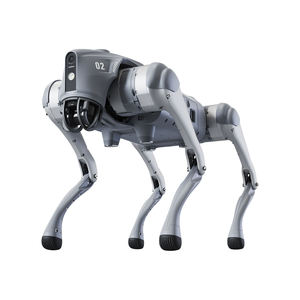
Petoi Bittle Control Board Architecture: BiBoard vs. NyBoard
An exhaustive engineering breakdown of power distribution networks, signal integrity parameters, CE compliance protocols, and embedded kinematics engines for institutional procurement directors.
High-Density Multi-Axis Servo Control & Power Bus Integrity
Quadruped robots operate under severe mechanical dynamic loading. Unlike conventional two-wheeled educational robots where motors draw a smooth, continuous current curve, a 9-DOF or 12-DOF bionic quadruped like Petoi Bittle or Nybble subjects its control PCB to rapid, transient microsecond surge currents across multiple PWM channels simultaneously. When eight core joint servos reverse phase during high-speed trot gaits, aggregate inductive current spikes can exceed 5.5A at 7.4V input.
The Petoi BiBoard (ESP32-WROOM-32D / Xtensa Dual-Core 32-bit LX6 MCU) resolves this via an isolated dual-rail Power Distribution Network (PDN). Logic circuitry is decoupled from high-amperage servo rails through low-ESR solid tantalum capacitors, Schottky barrier diodes, and dedicated ultra-low-dropout (LDO) linear regulators delivering a steady 3.3V to the core processor and 6-axis IMU (Inertial Measurement Unit). This prevents brownouts, memory corruptions, and IMU zero-point drift during aggressive kinematic maneuvers.
- Hardware PWM Precision: 16-channel PCA9685 I2C expansion driver offloading timer interrupts from the primary MCU.
- Inertial Tracking Integration: On-board MPU6050/ICM-42670 motion sensor executing dynamic balance and self-righting algorithms.
- CE Electromagnetic Compatibility: Ferrite-bead line filtering suppress switching noise to satisfy EN 55032 Class B thresholds.
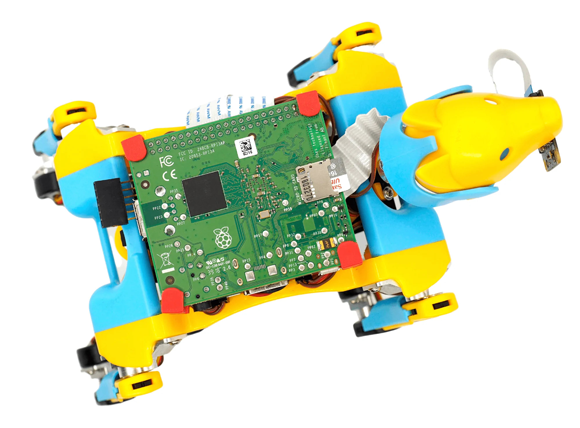
Hardware Specification & Engineering Matrix: BiBoard vs. NyBoard
| Architecture Metric | NyBoard V1.2 (Legacy Arduino) | BiBoard V1.0 (Flagship ESP32) | Procurement Impact & Industrial Fit |
|---|---|---|---|
| Primary Microcontroller | ATmega328P (8-bit AVR @ 16 MHz) | ESP32-D0WD-V3 (Dual-Core 32-bit @ 240 MHz) | 15x computational headroom for real-time inverse kinematics. |
| Flash / SRAM | 32 KB Flash / 2 KB SRAM | 4 MB SPI Flash / 520 KB SRAM + 8 MB PSRAM | Permits local voice lookup tables, gait dictionaries, and buffer heaps. |
| Wireless Protocol | External Bluetooth Dongle (UART) | Native Wi-Fi 802.11 b/g/n & Dual-mode Bluetooth 4.2 BR/EDR/BLE | Zero external dongles; supports remote OTA firmware flashes and REST APIs. |
| Servo PWM Channels | 16 Channels via PCA9685 (I2C Bus) | 16 Channels via Integrated Co-processor / High-Res MCPWM | Sub-microsecond pulse resolution ensures jitter-free servo holding torque. |
| CE Certification Scope | EMC 2014/30/EU (EN 55032 / EN 55035) | RED 2014/53/EU, RoHS 2011/65/EU, EN 62368-1 | Mandatory for direct importation into EU schools, universities, and labs. |
| Host SBC Co-Processing | Serial TX/RX (Level-shifted 5V to 3.3V required) | Direct 3.3V UART Header (Raspberry Pi, Jetson Nano compatible) | Plug-and-play AI Edge integration without level-shifting daughterboards. |
Industrial-Grade SMT Fabrication & Quality Control Systems
Our Shenzhen manufacturing center operates under strict ISO9001:2015 standards, providing end-to-end PCBA production, automated flying probe testing, and turnkey robotics assembly.
Every production batch undergoes full radiated emission and hazardous material laboratory verification.
Guaranteed by dual 3D AOI (Automated Optical Inspection) and flying-probe ICT testing on every PCB.
High-speed Panasonic and Yamaha SMT mounters handle 0201 passives and fine-pitch BGA microcontrollers.
Thermal chamber cycle testing under maximum continuous 16-channel servo load simulation.
High-Precision Component Placement
Our surface mount lines utilize multi-head automated mounters capable of placing miniature components down to 0201 metric chip scale, along with ultra-fine pitch QFN and BGA packages. Solder paste printing is verified via 3D SPI (Solder Paste Inspection) to eliminate bridged solder and voiding defects before reflow soldering occurs in 10-temperature-zone nitrogen reflow ovens.
Full CE & Radio Equipment Directive (RED) Audit
For overseas distributors, hardware legality in destination markets is paramount. All Petoi Bittle control boards comply with the European Union Low Voltage Directive (LVD 2014/35/EU), Electromagnetic Compatibility Directive (EMC 2014/30/EU), and Radio Equipment Directive (RED 2014/53/EU). We supply accredited test house reports (EN 300 328, EN 301 489, EN 62368-1) for smooth customs clearance.
Turnkey OEM/ODM Firmware Provisioning
Beyond raw SMT hardware assembly, our Shenzhen facility handles automated flashing of OpenCat firmware, custom bootloaders, factory calibration data, and unique MAC addresses. Every board undergoes dynamic automated servo calibration via specialized jig beds that measure mechanical angle accuracy, current draw, and Bluetooth/Wi-Fi RSSI power thresholds prior to packing.
Future Procurement & Technological Trends in Bionic Control Hardware
Strategic insights for educational purchasers, academic researchers, and commercial distributors navigating the next five years of embedded quadruped robotics hardware.
1. Edge AI Neural Processing Units (NPUs) on Controller Boards
The industry is transitioning away from pure microcontroller boards to hybrid heterogeneous architectures. The next iteration of Petoi-compatible controller boards integrates dedicated low-power Micro-NPUs (such as ESP32-S3 or Kendryte K210) running quantized TensorFlow Lite models directly on the board. This allows real-time optical target following, acoustic direction-of-arrival (DoA) detection, and gesture recognition without placing thermal or power burdens on secondary single-board computers.
2. Standardized Fieldbus & Smart Bus-Servo Transition
Traditional parallel 3-wire analog PWM connections require cumbersome wiring looms (power, ground, signal for 9 to 16 servos), increasing maintenance overhead in educational classrooms. The strategic procurement trend leans heavily toward daisy-chained serial bus servos communicating via half-duplex UART or CAN bus. This upgrade allows two-way telemetry: the controller can monitor each motor's internal temperature, real-time angular position, torque resistance, and over-current state.
3. Supply Chain Resilience & Pin-to-Pin MCU Redundancy
Following post-pandemic component volatility, enterprise procurement protocols require secondary sourcing designs. Leading factories now lay out dual-footprint PCBA layouts capable of accepting both native Espressif modules and pin-compatible domestic alternatives without redesigning the outer chassis or mechanical mounting holes. Furthermore, CE RoHS 3 (Directive 2015/863) compliance is strictly verified down to raw solder alloys and flux chemistry.
Looking for Custom OEM/ODM Petoi Bittle Control Board Production?
Whether you require customized PCB form-factors, pre-configured sensor arrays, specialized firmware flashing, or complete institutional laboratory class-sets with CE/FCC certification documentation, our engineering team is ready to support your supply chain requirements.
Contact UsFrequently Asked Questions for Sourcing & Procurement
In-depth technical answers addressing servo load tolerances, firmware compatibility, European compliance certifications, and wholesale minimum order quantities.
What specific standards are covered under the CE Certification for your Petoi Bittle control boards?
How does the BiBoard manage thermal dissipation during sustained 16-channel servo operation?
Is the board compatible with third-party microcontrollers, ROS (Robot Operating System), and Python?
What are the minimum order quantities (MOQ) and lead times for OEM/ODM hardware customization?
How does the board protect against accidental reverse polarity and servo stall conditions?
Can schools and distributors receive formal educational volume proposals and tax documentation?
Have unique engineering parameters or need an immediate formal tender quote?
Contact Us