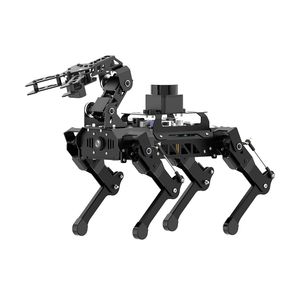
#1
OpenCat System On GitHub
16+ DOF
Synchronized Servo Control
< 1.8ms
Real-time Bus Response
100%
Rigorous Burn-in Tested
Procurement Whitepaper
High-Precision Dynamic Bionic Controllers: OEM & System Integration
As quadruped robotics pivots from novelty gadgets to institutional STEM curricula, edge artificial intelligence labs, and industrial automation inspection, the Petoi Bittle controller ecosystem—anchored by NyBoard and BiBoard architectures—has emerged as the premier global benchmark for sub-kilogram bionic locomotion.
Hardware Platforms & Integrated Kits
Verified Controller-Compatible Bionic Systems & Robotics Modules
Explore production-grade quadruped chassis, intelligent controller boards, companion peripherals, and industrial marking equipment engineered to direct supply-chain standards.
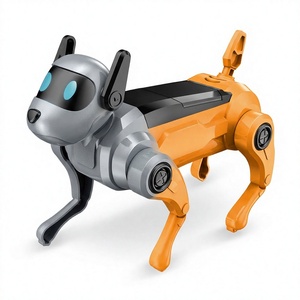
AI Smart RC Quadruped Robot Dog Toy Kit for Self Assembly

AI Powered Plush Companion Robot with Natural Voice Chat

AI Smart Interactive Emotional Pet Robot with Embedded Engine
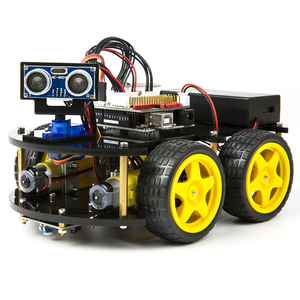
Robotlinking 4WD Open Educational Controller STEM Platform
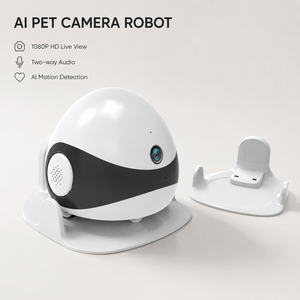
ABS Dynamic Quadruped Robot with HD Vision & Autonomous App
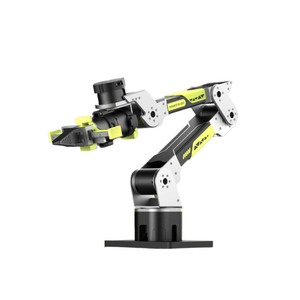
Seeed Studio B601-DM Isaac Sim ROS1/ROS2 Controller Board
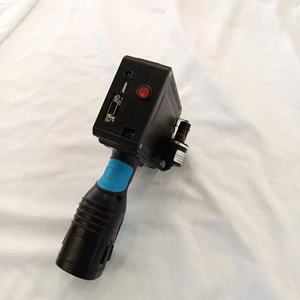
Industrial Assembly Batch Laser & CIJ Inkjet Marking Unit
Engineering Deep-Dive
Hardware Architecture: NyBoard (AVR) vs. BiBoard (ESP32) Execution
A rigorous breakdown of controller topography, bus timing, mathematical inverse kinematics computation, and multi-sensor bus multiplexing for industrial sourcing engineers.
Dual-Core Real-Time Processing
The modernization from traditional ATmega328P architectures to the BiBoard ESP32 series unlocks 240MHz asymmetric dual-core execution. Core 0 dedicates compute cycles strictly to high-frequency IMU balancing filters (MPU6050 6-axis DMP) and dynamic Inverse Kinematics (IK), while Core 1 processes high-throughput BLE, Wi-Fi teleoperation, and asynchronous Python JSON API commands with zero control-loop jitter.
PCA9685 16-Channel PWM Matrix
Precision bionic gait stability requires sub-microsecond servo pulse timing. Our China manufacturing line integrates hardware-grade I2C-driven PCA9685 PWM drivers backed by dedicated buck-boost power regulators. This guarantees 12-bit resolution per joint, isolating logic circuits from transient inductive voltage spikes when high-torque coreless or metal-gear servos operate under full stall loads.
OpenCat Framework Native Support
Hardware without firmware maturity creates systemic integration failure. As certified Petoi Bittle controller supply partners, our boards ship flash-calibrated with the latest production branch of the OpenCat C++ gait locomotion engine. OEM clients acquire immediate compatibility with visual Skill Composer tools, ROS 1 / ROS 2 locomotion bridges, and edge vision models.
| Evaluation Parameter | Legacy NyBoard Architecture | BiBoard ESP32 Dynamic Platform | Enterprise Custom OEM Variant |
|---|---|---|---|
| Primary SoC / MCU | Microchip ATmega328P @ 16 MHz | Espressif ESP32-WROOM-32D @ 240 MHz | ESP32-S3 or STM32F407 High-Compute MCU |
| Motion Co-Processor | PCA9685 PWM (12-bit I2C Bus) | Integrated Hardware Timers + PCA9685 | Multi-Channel CAN-Bus / Serial Bus Control |
| Gait Calculation Frequency | 50 Hz Fixed Refresh Rate | 200 Hz - 500 Hz Real-Time Loop | Up to 1 kHz with Active Impedance Control |
| Direct Bus Connectivity | UART Serial, USB Dongle, FTDI | Native Wi-Fi 4, Bluetooth 4.2 BLE, UART | Wi-Fi 6, BLE 5.0, CAN 2.0B, RS485 Industrial |
| SBC Co-Mounting | Raspberry Pi Zero (Wired Serial) | Raspberry Pi 4B/5, Jetson Orin Nano | NVIDIA Jetson, CM4 Compute Blade Direct Mating |
| Supply Input Voltage | 7.4V (2S Lithium-Ion Configuration) | 7.4V - 8.4V with 5V/5A Step-down BEC | 9V - 24V Wide Range Industrial Input Protection |
Supply Chain Intelligence
Future Procurement Trends in Quadruped Controllers (2025–2030)
Actionable forecasting for university procurement heads, educational distributors, and robotics hardware OEMs evaluating inventory and architecture shifts.
Transition to Brushless & Smart Bus Actuation
While traditional RC-style PWM servos dominate low-cost education kits, enterprise tenders increasingly demand magnetic-encoding serial bus servos and field-oriented control (FOC) brushless drivers. Next-gen Bittle controllers integrate bidirectional half-duplex UART lines, allowing continuous monitoring of motor temperature, output torque, and angular displacement feedback.
NPU Integration at the Embedded Controller Tier
Procurement data confirms that buyers refuse isolated gait controllers. Tomorrow's standard specifications require controllers running TensorFlow Lite for Microcontrollers (TFLite-Micro) or integrated KPU/NPU acceleration. This allows the bionic pet to process wake-word audio cues, visual gesture recognition, and obstacle avoidance natively on the motherboard without requiring a bulky companion single-board computer.
Turnkey Curriculum & Institutional Compliance Bundling
Global buyers no longer source bare PCB assemblies in isolation. Procurement mandates demand full CE-RED, FCC ID, and RoHS certification alongside packaged multi-tier pedagogical assets—bridging graphical Scratch block editors, Python real-world telemetry analysis, and ROS 2 simulation files (Isaac Sim / Gazebo URDF).
Engineering Horizons
Evolutionary Trends: Reinforcement Learning & Edge Autonomy
How Chinese precision manufacturing and open-source software collaboration are driving the next wave of micro-legged bionic mobility.
Sim-to-Real Reinforcement Learning (RL)
Manual kinematic matrix mathematical modeling is transitioning toward neural network locomotion policies. Utilizing NVIDIA Isaac Gym, developers train thousands of virtual Bittle agents across irregular terrains in minutes. Our updated controllers provide high-speed serial pipe streaming to run neural network-generated gait parameters directly onto the physical chassis.
Over-The-Air (OTA) Swarm Telemetry
By leveraging ESP-NOW and Wi-Fi mesh protocols implemented on BiBoard motherboards, multiple Petoi Bittle units can coordinate formation maneuvers, collaborative payload transfer, and decentralized environment mapping without central server reliance—opening transformative avenues in STEM robotics competitions.
Hybrid Kinematic Modular Grippers
Quadrupeds are expanding beyond passive navigation. Contemporary development pairs the controller with 2-axis high-speed front manipulation arms. The controller’s dynamic center-of-mass (CoM) algorithms automatically adjust hind leg squat angles when the robot interacts with external objects, preserving equilibrium during complex grasp operations.
Factory Direct Supplier Advantage
Shenzhen Pbrobot Technology: Industrial Manufacturing Leadership
Headquartered in Shenzhen’s global hardware innovation corridor, our manufacturing infrastructure fuses open-source agility with aerospace-tier quality inspection, setting the global standard for Bittle controller distribution.
High-Speed SMT & Automated AOI
State-of-the-art surface-mount production lines capable of 0201 passives and micro-BGA placement, followed by automated optical inspection for zero-defect soldering.
100% Full-System Thermal Burn-In
Every controller board undergoes a continuous 48-hour automated multi-channel servo cycling and stress test under thermal loads prior to packaging and shipping.
Agile Turnaround & Custom Firmware
Direct flashing of client-proprietary firmware, custom PID calibrations, unique bootloaders, and customized silkscreen branding for volume institutional contracts.
End-to-End Bill of Materials (BOM) Control
Direct strategic partnerships with component suppliers guarantee authentic IC provenance, anti-counterfeit protection, and steady pricing stability against raw silicon fluctuations.
Educational Curriculum Licensing
Access ready-to-teach, multi-tier curriculum packages spanning middle school block environments to university level C++ and Python robotics engineering.
Worldwide Technical & RMA Lifecycle Support
Dedicated embedded software FAEs (Field Application Engineers) standing by to troubleshoot real-time communication stacks, URDF configurations, and customized board adaptations.
Procurement Inquiries
Frequently Answered Technical & Sourcing Questions
Clear, unvarnished specifications and logistics policies for engineering buyers, OEM distributors, and academic institutions.
What are the definitive architectural distinctions between NyBoard and BiBoard controllers?
NyBoard is built on an ATmega328P 8-bit architecture, representing a battle-tested, classic choice for foundational Arduino C++ education. It controls servos via an onboard PCA9685 PWM chip over I2C. In contrast, BiBoard leverages the dual-core 32-bit ESP32 platform, delivering built-in Wi-Fi and Bluetooth BLE, native hardware timer routines, direct support for complex real-time balance calculations, high-throughput serial pipelines to Raspberry Pi/Jetson computers, and larger memory space for extensive motion sequences and speech modules.
Which single board computers (SBCs) and artificial intelligence modules are mechanically and electrically supported?
Compact SBCs like the Raspberry Pi Zero, Zero 2W, and Raspberry Pi 3A+ can be mechanically screwed into the Bittle top plate and directly powered via the onboard BEC while communicating through a dedicated UART 4-pin header. Larger boards such as the Raspberry Pi 4B/5, NVIDIA Jetson Nano, and Jetson Orin Nano should communicate with the controller wirelessly via high-speed Bluetooth BLE or Wi-Fi UDP sockets, or receive dedicated auxiliary power to prevent overloading the robot’s main battery bus.
How does the controller maintain gait stability during payload variations or external disturbances?
The board integrates an onboard 6-axis IMU (MPU6050 or ICM series) running embedded digital motion processing (DMP). The OpenCat firmware samples pitch, roll, and yaw angles at high frequencies. When external forces induce tipping or when dynamic payloads shift the center of mass, the firmware calculates real-time compensatory angular offsets for all eight leg joint servos, executing immediate active posture correction.
What are the lead times, MOQ requirements, and customization options for bulk educational orders?
Standard controller units and robot kits ship from stock within 3 to 7 business days. Custom institutional orders (custom silkscreen branding, pre-flashed proprietary code, tailored sensor harnesses, or custom acrylic/molded chassis colors) feature a standard MOQ of 100 units with an average factory production turnaround of 3 to 4 weeks. Complete DDP air and sea freight logistics are supported globally.
Does the controller provide protection against servo stall currents and reverse polarity?
Yes. The PCB integrates robust power isolation between the delicate micro-controller logic rail and the inductive servo drive rails. Standard protection layers include Schottky reverse polarity protection, resettable PTC fuses for short-circuit events, transient voltage suppression (TVS) diodes, and decoupling capacitor arrays to dampen servo back-EMF spikes during heavy impacts.
What programming environments and software libraries are supported out of the box?
The ecosystem supports Scratch-based block programming (Mind+ / Petoi Coding Blocks) for young learners, native Arduino IDE C++ for embedded firmware development, and comprehensive Python API wrappers for Raspberry Pi and desktop control. In addition, the Petoi Desktop App provides an intuitive visual joint calibration matrix and a keyframe-based Skill Composer for designing original gaits and acrobatic behaviors.
Accelerate Your Robotics Pipeline with Factory-Direct Engineering
Whether configuring a 500-seat university engineering laboratory, integrating bionic controller boards into proprietary automation solutions, or establishing regional distributorships—our direct engineering team provides customized proposals, quotation sheets, and firmware evaluation kits.