Engineered for Education, Research Labs & Consumer AI Deployment
Source directly from China's primary production base. Standardized modular robotics kits fully compatible with OpenCat, Raspberry Pi 3A+/4B/Zero 2W, ESP32 BiBoard, and Arduino microarchitectures.
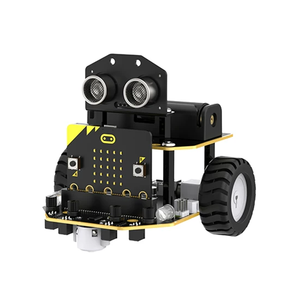
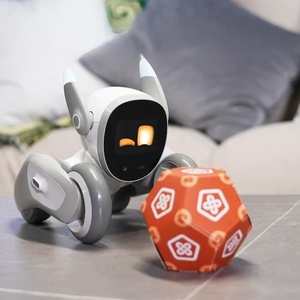
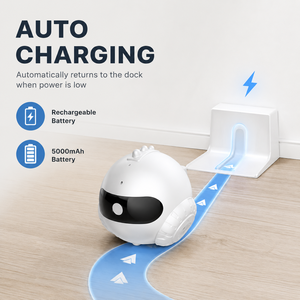
Technical Architecture: Petoi Bittle Meets the Raspberry Pi Ecosystem
In modern biomechatronics and educational robotics, the convergence of embedded motor coordination and high-level artificial intelligence processing represents the gold standard of hardware engineering. The Petoi Bittle platform, driven by the renowned OpenCat open-source robotic architecture, utilizes a heterogeneous dual-tier compute topology. Low-level gait planning, inverse kinematics (IK) calculations, and microsecond-level pulse-width modulation (PWM) servo timing are managed natively on dedicated real-time microcontrollers—either the ATmega328P-based NyBoard or the dual-core 240MHz ESP32 BiBoard. This micro-tier abstracts the complex mathematical physics of quadrupedal dynamic balance, leg coordination, and gyro-stabilized posture recovery.
By mounting a Single Board Computer (SBC)—specifically the Raspberry Pi 3A+, 4B, or Raspberry Pi Zero 2W—directly atop the precision-molded bionic chassis, engineers and researchers unlock edge machine learning capabilities. Communication is established via high-speed serial UART over standard 2.54mm GPIO pins. In this master-slave architecture, the Raspberry Pi serves as the autonomous brain executing real-time OpenCV edge vision, simultaneous localization and mapping (SLAM), deep reinforcement learning policy inference, and natural language understanding (LLM processing). Meanwhile, the Petoi base acts as the real-time spinal cord executing complex gait cycles without introducing processing jitter or threading latency to the high-level Linux OS.
Edge AI & Hardware Telemetry Specifications
Engineered for seamless research-grade instrumentation without custom PCB fabrications.
- Physical Interfacing: Direct header mating for Pi Zero 2W / 3A+ with vibration-dampened nylon standoffs.
- Baud Rate Protocol: High-throughput 115,200 / 500,000 bps serial bus with packetized checksum security.
- Power Architecture: Isolated step-down switching buck regulators ensuring steady 5V/3A rails without back-EMF feedback.
- Python API Support: Fully documented open-source Python SDK for programmatic gait triggers and servo telemetry.
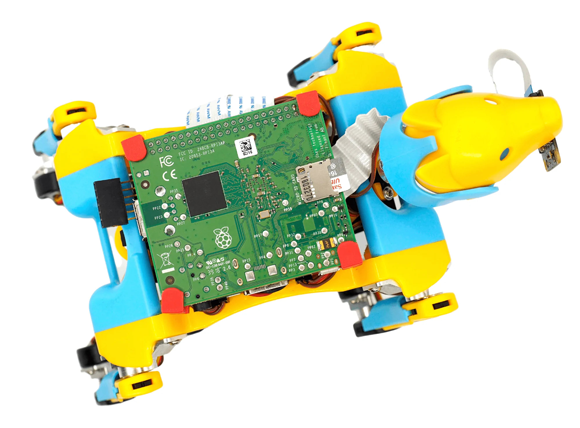
Bittle Quadruped Chassis Fitted with Raspberry Pi and Dual-Lens Vision Sensor
Emerging Trends in Global Biomimetic Robotics Procurement
The academic and technical procurement landscape for desktop quadruped robots is witnessing a paradigm shift. Institutions are pivoting away from rigid, proprietary educational platforms toward modular, hackable ecosystems that support lifecycle longevity. As institutional buyers evaluate tenders for computer science, robotics, and STEM faculties, three prevailing trajectories govern procurement specifications:
1. Edge AI & Generative Agent Fusion
Procurement mandates increasingly demand direct on-board neural execution. Robotics fleets must now execute compact multimodal LLMs and visual SLAM pipelines without cloud dependency, creating surging demand for Raspberry Pi 4B/5 and Jetson-compatible quadruped chassis.
2. Low Total Cost of Ownership (TCO)
Full-size industrial quadruped dogs (costing $15,000 to $75,000 per unit) expose institutions to crippling replacement liabilities during student laboratory sessions. Palm-sized, high-tensile injection-molded quadrupeds reduce unit deployment costs by 95% while offering identical kinematic degrees of freedom.
3. Progressive Educational Scaffolding
Modern curricula require cross-disciplinary adaptability. Hardware must transition smoothly from K-12 block-based graphical programming (Scratch/Mind+) to embedded real-time C++ gait optimization, concluding in university-level Python/ROS robotics operating environments.
Technological Horizons: Dynamic Locomotion & Manipulation
The progression of bionic quadrupeds spans far beyond basic pre-compiled movement routines. The engineering trajectory is defined by hybrid manipulation capabilities, such as mounting 2-DOF and 3-DOF robotic arm grippers directly onto the back of the Bittle frame. This converts a passive walking chassis into an active mobile manipulation robot capable of navigating complex obstacles, identifying target objects via onboard machine vision, and picking/sorting payloads autonomously.
Simultaneously, the open-source community is deploying reinforcement learning (RL) sim-to-real transfer pipelines utilizing NVIDIA Isaac Gym and MuJoCo simulation suites. Virtual models of the Petoi Bittle undergo millions of simulated learning epochs to adapt to rough terrain, gravel, inclines, and exterior disruptions. When the learned neural network policy weights are flashed onto the Raspberry Pi, the physical Bittle exhibits spontaneous, bio-inspired recovery reflexes that closely mirror biological canines.
Shenzhen Factory Capabilities & OEM/ODM Wholesale Engineering
Headquartered in the global electronics manufacturing heartland of Shenzhen, our facility operates with uncompromising commitment to production precision, component durability, and end-to-end supply chain integration. As the dedicated manufacturer and global wholesaler behind the Petoi Bittle and OpenCat ecosystem, we bridge the gap between open-source agility and industrial-grade volume output.
Injection Mold Rigidity
Constructed with shock-absorbing, high-strength ABS/PC composite polymers. Components withstand repeated high-impact collisions and classroom stresses without mechanical fracturing.
Custom Servo Calibration
Equipped with high-precision, metal-geared coreless digital servos tailored for high torque holding, minimal deadband, and thermal overload protection under sustained gaits.
Comprehensive White-Labeling
From custom silicone chassis coatings and institutional silkscreening to localized packaging, branded quick-start guides, and custom board BIOS flashing for global educational publishers.
Tier-1 Quality Assurance
Rigorous burn-in testing protocols, full automated optical inspection (AOI) for circuit assemblies, and UN38.3/CE/FCC/RoHS compliance certifications for frictionless international shipping.
Procurement Due Diligence
Frequently Asked Questions for B2B Importers & Educators
Key technical specifications, interoperability parameters, and logistics procedures answered directly by our factory engineering team.
Which Raspberry Pi single board computers can be physically mounted and integrated? +
The Petoi Bittle chassis is mechanically and electronically optimized for compact Raspberry Pi boards, notably the Raspberry Pi 3A+ and the Raspberry Pi Zero 2W. Both form factors align directly with the dedicated mounting posts on the upper frame, preserving a low center of gravity critical for quadruped gait stability. Standard models like the Raspberry Pi 4B can be wired via extended jumper ribbon cables or integrated wirelessly over a local Wi-Fi UDP/TCP socket network. When mounted natively, the Pi draws regulated 5V power from our onboard power distribution board and interfaces with the BiBoard/NyBoard via serial UART Rx/Tx pins.
What is the payload capacity for additional sensors, cameras, and batteries? +
The standard Bittle platform comfortably accommodates sustained functional payloads between 100g and 150g without degrading servo gear life or compromising dynamic balance. This payload budget easily supports a Raspberry Pi Zero 2W (15g), a wide-angle 5MP/8MP camera module (10g), an auxiliary ultrasonic sensor (9g), and supplementary Li-ion battery capacity. For higher payloads (up to 250g), our factory provides high-torque, metal-geared coreless servo upgrades along with calibrated high-load inverse kinematic firmware presets.
Do you offer turnkey educational bundles including curricula and teacher lesson guides? +
Yes. As an authoritative supplier to global academic bodies, we provide comprehensive, turn-key curriculum packages aligned with CSTA and NGSS standards. Our material covers a 16-week progression spanning introductory visual block programming (Mind+/Scratch), intermediate sensor-triggered behavioral design, advanced embedded C++ programming, and college-level Python automation with OpenCV. The packages feature fully scripted educator slide decks, lab assignment sheets, evaluation rubrics, and step-by-step troubleshooting wikis.
What are the lead times, MOQ thresholds, and sample evaluation terms for wholesalers? +
Standard evaluation units (pre-assembled or DIY kits) are dispatched from factory inventory within 48 to 72 business hours via expedited air freight (DHL/FedEx/UPS). For commercial wholesale orders, our Minimum Order Quantity (MOQ) starts at 20 units for standard factory specifications, and 200 units for customized OEM orders featuring institutional silk-screening, custom molded casing colors, and specialized peripheral kit packaging. Volume production lead times range between 15 to 25 calendar days depending on component availability and customization depth.
How does OpenCat ensure long-term software support and avoid proprietary vendor lock-in? +
The OpenCat framework is entirely open-source under permissible licensing, with active community contributions maintained on GitHub since 2018. Because the underlying hardware is architected around mainstream Espressif (ESP32) and Microchip (ATmega328P) microcontrollers, schools and research teams are never dependent on proprietary cloud servers or expiring software subscription models. Code can be flashed and compiled via standard Arduino IDE, VS Code, PlatformIO, or native Linux toolchains, safeguarding your hardware investment for years to come.