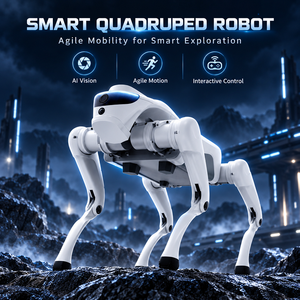
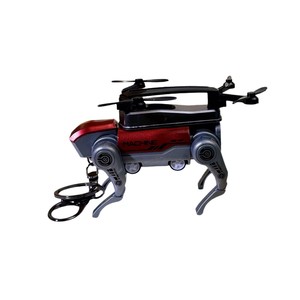
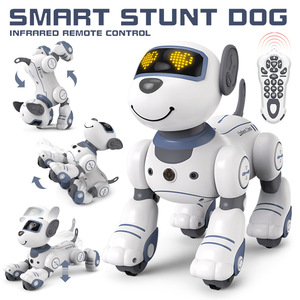
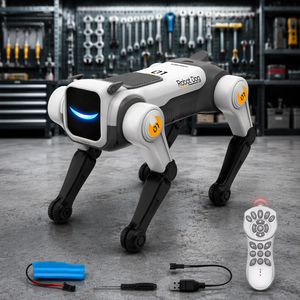
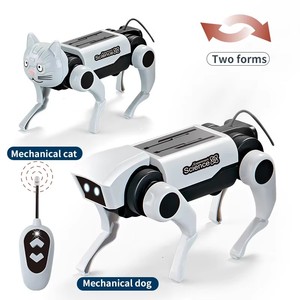
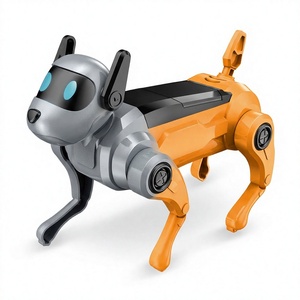
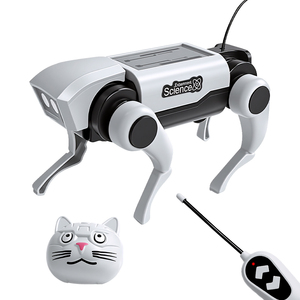
Explore our industrial bionic quadruped and companion hardware lines. Available for immediate procurement, educational deployment, or bespoke white-label OEM engineering.
The Evolution of Custom Quadruped Robotics Manufacturing
Navigating the convergence of embodied AI, biomimetic gait dynamics, and lean OEM/ODM industrial supply chains.
The commercial landscape for quadruped bionic robots has transitioned from academic novelty to industrial feasibility. Globally recognized platforms like the Petoi Bittle and its open-source framework, OpenCat, have established an entirely new design standard: democratizing high-DOF (Degrees of Freedom) biomimetic gaits within compact, ultra-lightweight form factors. As leading custom OEM/ODM manufacturers, our objective centers on overcoming the triad barrier typical to legged hardware: mechanical joint wear, dynamic inverse kinematics latency, and exorbitant unit procurement costs.
By consolidating precision digital coreless servos, custom injection-molded carbon-fiber/ABS blended unibodies, and distributed microcontrollers (ESP32-BiBoard and NyBoard architectures), we empower distributors, institutions, and industrial partners to commission custom hardware solutions at scale. Whether configuring voice-commanded companions or edge-computing research dogs with secondary single-board computers (Raspberry Pi 4B/Zero, NVIDIA Jetson Nano), our engineering pipeline mitigates the friction of system integration.
Next-Generation Bionic Gait Optimization via Edge Computing
Traditional wheeled robots struggle when confronting uneven terrain, steps, and dynamic outdoor environments. The Petoi Bittle framework overcomes this limitation through closed-loop kinematic control. Each leg features specialized high-torque metal-gear servos synchronized via real-time interrupt routines that execute 50Hz dynamic balancing loops. When designing OEM derivatives, we calibrate the center of gravity (CoG) and configure onboard IMUs (Inertial Measurement Units) to enable reflexive self-righting protocols—a crucial criterion for institutional clients operating intensive lab cycles.
Edge AI Sensor Integration
Procurement teams increasingly mandate onboard vision processing. Modern requests specify dual-core architectures pairing ESP32 base controllers with edge vision accelerators (K210 or ESP32-S3 Cam) capable of offline object classification, facial recognition, and SLAM navigation.
Open Standards & Anti-Lock-in
Educational and enterprise tenders now actively penalize proprietary black-box ecosystems. Buyers insist on modular hardware operating on open-source C++, Arduino IDE compatibility, and rich Python serial bindings to guarantee multi-year instructional longevity.
High-Stress Actuator Durability
The primary point of field failure in quadruped fleets is gear stripping. Enterprise procurement has shifted towards hybrid steel-brass geartrains with overcurrent thermal shutdown sensors, drastically slashing replacement overhead in institutional environments.
Kinematic Benchmarking
Technical Specification & System Integration Matrix
A rigorous comparative breakdown between our custom OEM quadruped framework and prevailing industry alternatives.
Evaluation Parameter
Petoi Bittle Framework (Custom OEM)
Generic Toy-Grade RC Dogs
Heavyweight Industrial Quadrupeds
Core Kinematic Degrees of Freedom
9 to 16 Active DOF (Full Coordinate Mapping)
4 to 6 Crank-driven Non-programmable Linkages
12 to 16 High-voltage Harmonic Drive Joints
Processing & Logic Controller
ESP32 Dual-Core (BiBoard) / ATmega328P (NyBoard)
Masked ASIC ROM (Fixed Routines)
Intel Core i7 / NVIDIA Jetson AGX Orin Cluster
Extensibility Architecture
I2C, SPI, Grove headers, UART for SBC/Vision modules
Zero external interface capabilities
Industrial CAN bus, GigE IP67 umbilical interfaces
Programming Frameworks
Block Coding (Scratch), Native C++, Python 3.x API
Infrared Keypad / Fixed RF Transmitters Only
ROS 2 Humble / C++ / Complex Simulation SDKs
Weight & Inherent Safety
~290g (Completely safe for desktop classrooms)
~600g (Fragile shell, minimal impact tolerance)
15kg to 55kg (Requires restricted safety perimeters)
Combining world-class biomimetic firmware engineering with Shenzhen's agile hardware prototyping and high-throughput production ecosystem.
Certified Quality Assurance
Rigorous multi-stage burn-in stress testing, ISO9001 compliance, and 100,000-cycle servo endurance benchmarking to eliminate field degradation.
Full-Stack Customization
From mold tooling adjustments, custom-branded chassis, and proprietary actuator gears to specialized firmware kernels and bespoke packaging.
Curriculum & SDK Supply
Turnkey STEM textbooks, digital classroom software suites, and open-source GitHub asset alignment that allow immediate educational monetization.
Worldwide Logistics & IPR
Strict intellectual property governance, secure international export escrow, CE/FCC/RoHS compliance certification, and rapid DDP shipping lines.
Procurement Clarity
Frequently Asked Questions for B2B & OEM Buyers
Direct answers to technical, commercial, and logistical criteria routinely raised during institutional procurement audits.
QWhat Minimum Order Quantities (MOQs) apply for bespoke OEM modifications?
For standard off-the-shelf assemblies with custom silk-screened logos and branded packaging, our baseline MOQ begins at 100 units. For comprehensive hardware revisions—such as modified injection molds, custom PCB motherboards, or bespoke actuator specs—the baseline MOQ starts at 500 to 1,000 units depending on tooling complexity.
QHow does the system handle high-bandwidth AI vision and single-board computer integration?
The platform provides dedicated serial UART and I2C lines directly to our BiBoard/NyBoard. Compact microcomputers like Raspberry Pi 3A+, Pi Zero 2W, or custom ESP32-CAM daughterboards mount mechanically on the back rail. Standard Python libraries communicate bidirectional telemetry, allowing the SBC to run inference and send coordinate commands to the gait controller.
QCan we procure the robots fully assembled, or is DIY kit form mandatory?
We provide dual supply pipelines: 100% factory pre-assembled and calibrated units (ideal for commercial gifting, retail distribution, or research institutes who need zero setup overhead) as well as knocked-down DIY assembly kits (tailored for STEM curriculum programs that emphasize hands-on mechanical aptitude).
QWhat regulatory international certifications accompany bulk exports?
All production runs strictly conform to CE (RED), FCC Part 15 Class B, RoHS directive 2011/65/EU, and EN71/ASTM-F963 safety standards where applicable. Lithium polymer battery packs include comprehensive UN38.3 test reports, MSDS documentation, and drop-test verifications to ensure compliant air and sea cargo handling.
QWhat is the expected lifespan of the joint servos under continuous lab operations?
Our custom high-torque metal-gear digital servos are rated for >180 hours of continuous dynamic walking cycles. Furthermore, our firmware includes anti-stall protection and thermal soft-limiting that dynamically reduces duty cycles if a limb encounters an immovable obstacle, drastically minimizing gear stripping.
QAre proprietary software licenses required to operate the robot fleets?
No. The entire underlying framework is founded upon open-source principles (OpenCat architecture). Users utilize the free Petoi Desktop App, Skill Composer, open-source mobile controllers (iOS/Android), and Arduino IDE / Python repos without recurring software license fees or subscription dependencies.
Kickstart Your Custom OEM Bionic Robotics Program
Consult with our lead hardware architects to discuss component customizations, fleet volume pricing tiers, or tender documentation support.