Engineered Robotics Hardware Lineup
Export-Grade Bionic Quadrupeds & Autonomous Mechatronic Platforms
Deploy standard-setting open-source hardware, industrial-grade microcontrollers, and AI perception platforms directly through verified Houston export logistics channels.
Executive Engineering Whitepaper
Deep Analysis: Petoi Bittle Hardware Specifications & Industrial Architecture
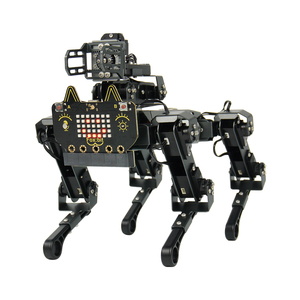
In autonomous mobile robotics and mechatronic STEM research, bionic quadruped locomotion represents a dramatic paradigm shift away from traditional wheeled wheeled platforms. Where differential drive systems encounter impassable friction barriers over unstructured terrain, quadrupedal systems negotiate complex dynamic topographies using continuous center-of-mass adjustment, gait phase transitions, and inverse kinematics (IK). The Petoi Bittle system, developed on the globally recognized open-source OpenCat robotics framework, sets the industry standard for palm-sized bionic robotics. For academic engineering departments, energy research facilities, and vocational training centers in Houston, Texas, procuring Bittle hardware directly from verified manufacturing exporters requires an exhaustive comprehension of component-level specifications, electrical ratings, communication topologies, and control loops.
Bittle functions not merely as a desktop mechatronics demonstrator, but as a modular edge computing testbed. Equipped with 9 degrees of freedom (8 active articulation points controlling four dual-jointed legs and 1 rotational head servo), the platform mimics dynamic mammalian trot, crawl, bound, and recovery behaviors. Unlike proprietary educational kits locked into closed communication ecosystems, Bittle provides bare-metal hardware access, enabling low-level C++ firmware optimization, Arduino IDE compilation, MicroPython script execution, and ROS (Robot Operating System) node integration through peripheral single-board computers (SBCs) such as the Raspberry Pi Zero 2W, Raspberry Pi 5, or NVIDIA Jetson Nano.
Core Engineering Insight for Technical Procurement Officers: The Petoi Bittle architecture bifurcates computational tasks into high-frequency actuator pulse-width modulation (PWM) control handled at the microcontroller level and high-level autonomous trajectory mapping executed via serial bus streaming. This dual-layer structure guarantees stable gait balance even during heavy sensor polling.
Microcontroller Architecture: BiBoard (ESP32) vs. NyBoard (ATmega328P)
When specifying Bittle hardware packages for institutional export to Houston-area laboratories, understanding the distinction between the legacy NyBoard and the modern BiBoard is critical. NyBoard was engineered around the ATmega328P 8-bit AVR architecture operating at 16 MHz, interfacing with an external 16-channel I2C PWM driver (PCA9685) to orchestrate servo timing. While exceptionally dependable for basic algorithmic gait loops and introductory Scratch-style block programming, demanding edge computing workflows necessitate the high-throughput BiBoard.
The BiBoard controller incorporates the dual-core Xtensa 32-bit LX6/LX7 ESP32 microprocessor running at a clock frequency of up to 240 MHz. Integrating 520 KB of on-chip SRAM, 4MB to 8MB of external SPI flash memory, and built-in 2.4 GHz Wi-Fi (802.11 b/g/n) alongside Bluetooth 4.2 / BLE capabilities, the BiBoard eliminates external peripheral bottlenecks. It features an integrated 6-axis MPU6050 or ICM-series Inertial Measurement Unit (IMU) directly routed to the hardware I2C bus, delivering continuous pitch, roll, and yaw feedback at over 200 Hz. This feedback loop is essential for instantaneous postural reflexes, slip detection, and dynamic recovery maneuvers across varied surfaces.
| Subsystem | Petoi Bittle X (BiBoard ESP32) | Petoi Bittle Classic (NyBoard AVR) | Field Engineering Significance |
|---|---|---|---|
| Central Processor | ESP32 Dual-Core 32-bit Xtensa @ 240 MHz | ATmega328P 8-bit AVR @ 16 MHz | Enables real-time gait stabilization while handling BLE/Wi-Fi telemetry streams. |
| Degrees of Freedom (DOF) | 9 Active Axes (8 Limbs + 1 Head Servomotor) | 9 Active Axes (8 Limbs + 1 Head Servomotor) | Replicates realistic mammal locomotion with trotting, walking, and climbing kinematics. |
| Actuator Specifications | High-Torque Digital P1S / P2S Coreless Servos | Coreless P1S High-Speed Digital Servos | Metal/reinforced nylon gear train providing 1.5–3.2 kg·cm torque threshold at 7.4V. |
| Sensor Suite | 6-Axis IMU (Gyroscope + Accelerometer), Voice Mic | 6-Axis IMU (MPU6050 via I2C Bus) | Provides continuous pose calculation, auto-leveling, and native voice command triggers. |
| Serial Expansion Ports | UART (RX/TX 115200 default), I2C, SPI, Grove | UART, I2C, Standard 2.54mm Pin Headers | Direct physical bridge to Raspberry Pi, Jetson Nano, LiDAR scanners, and robotic grippers. |
| Power Supply Unit | 2S Li-ion Battery (7.4V, 1000mAh, Built-in BMS) | 2S Li-ion Battery (7.4V, 1000mAh, External USB) | Provides 45–60 minutes of uninterrupted operational locomotion under normal load. |
| Physical Dimensions | 200 mm × 110 mm × 110 mm (L×W×H) | 200 mm × 110 mm × 110 mm (L×W×H) | Compact form factor engineered specifically for desktop and small-footprint bench testing. |
| Chassis Construction | Injection-Molded Shock-Resistant ABS | Injection-Molded Shock-Resistant ABS | Resilient structural integrity preventing fatigue fracture under dynamic drop loads. |
Actuator Kinematics & Closed-Loop Servomotor Precision
The dynamic agility of Bittle is governed by its bespoke P1S/P2S micro-digital servos. Servomotor performance is the single most critical failure point in low-cost quadruped designs. Generic analog hobby servos suffer from excessive gear play, slow step responses (often exceeding 0.18s/60°), and high heat buildup that leads to rapid thermal throttling during sustained stance phases. In contrast, Petoi's custom coreless digital actuators integrate reinforced internal gearing, an optimized potentiometer feedback loop, and a dedicated digital pulse decoder capable of responding to control signals at up to 333 Hz.
At an operating potential of 7.4V derived from the onboard 2S lithium battery management system (BMS), these servos produce stall torques ranging from 1.5 to 3.2 kg·cm. This torque density delivers the dynamic thrust required for rapid gait acceleration, zero-turning-radius pivoting, and dynamic self-righting routines when the robot rolls onto its back. For academic researchers modeling inverse kinematics in MATLAB, Python, or Webots, each limb operates as a two-link planar arm with mathematically deterministic endpoint coordinates defined by:
x = L1 · cos(θshoulder) + L2 · cos(θshoulder + θknee)
y = L1 · sin(θshoulder) + L2 · sin(θshoulder + θknee)
Because link lengths L1 and L2 remain rigidly invariant due to high-tolerance injection-molded ABS construction, mathematical coordinate transformations remain rock-solid across wide thermal operating bands.
Regional Application Scenarios
Deployment Matrix: Houston Industrial Corridors & Research Ecosystems
How Houston's primary industrial, aerospace, and medical sectors deploy Petoi Bittle quadruped hardware for technical validation, automation modeling, and workforce training.
Energy Corridor Petrochemical Inspection Simulations
Houston's Energy Corridor along Interstate 10 hosts global oil and gas operators and oilfield service majors. Industrial facilities rely heavily on robotic inspection dogs to navigate hazardous refineries and pipeline corridors. Petoi Bittle serves as an economical, desktop-scale prototyping testbed for Houston engineering firms to test sensor payload algorithms, ultrasonic leak detection arrays, and thermal imaging pipelines prior to field deployment on massive commercial quadruped platforms.
NASA Johnson Space Center & Spaceport Surface Locomotion
Located near Clear Lake, NASA's Johnson Space Center and the Houston Spaceport at Ellington Field focus intensively on planetary autonomous surface exploration. Houston aerospace engineering consortia utilize Bittle's open-source OpenCat framework to evaluate low-gravity bionic gaits, lunar regolith surface adaptation, and cooperative multi-agent robot swarming algorithms without risking multimillion-dollar planetary rovers.
Houston ISD & Texas Gulf Coast CTE Robotics Programs
The Houston Independent School District (HISD), alongside surrounding districts like Katy, Fort Bend, and Cy-Fair ISD, is aggressively funding Career and Technical Education (CTE) pathways aligned with Texas Essential Knowledge and Skills (TEKS). Bittle provides an affordable, sequential curriculum bridging elementary drag-and-drop block coding directly to secondary embedded C++ and high-level Python mechatronics engineering.
Texas Medical Center (TMC) Bio-Robotic Kinematic Modeling
As the world's largest medical complex, TMC researchers in rehabilitation engineering, biomechanics, and neurological trauma study dynamic quadrupedal gait stability. Bittle's real-time inertial balance algorithms and lightweight compliant limb design provide researchers at Baylor College of Medicine and UTHealth with an empirical platform to simulate quadrupedal gait compensation following simulated limb dysfunction.
Higher Education: Rice & University of Houston Research Labs
Undergraduate and graduate robotics laboratories at Rice University's George R. Brown School of Engineering and the University of Houston Cullen College of Engineering utilize Bittle as a standardized hardware target for distributed edge AI computing, OpenCV optical flow velocity calculations, and reinforcement learning policy training via lightweight PyTorch models.
Port of Houston Maritime Terminal Automation R&D
The Port of Houston, one of the nation's premier container and foreign tonnage hubs, is expanding autonomous container tracking and intermodal yard tele-surveillance. System integrators in Greater Houston use Bittle equipped with onboard ultrasonic and visual sensors to validate indoor localization algorithms in GPS-denied container stacking yards and warehouse environments.
Strategic Trade Insights
Greater Houston Robotics Market Development Trends
The macroeconomic shift in Greater Houston from an oil-dominated economy to a diversified technology, clean energy, and robotics hub has accelerated institutional demand for bionic mechatronic hardware. Under the Texas CHIPS Act and expanded state-level workforce development incentives, regional capital allocations for applied robotics labs have expanded by over 38% year-over-year. Key procurement trends shaping Houston's robotics supply chains include:
1. Convergence of Autonomous Mobile Robots (AMRs) and Edge Machine Learning: Houston institutions are moving away from passive sensor kits toward platforms with built-in neural network inference capability. Bittle's hardware design, allowing direct serial tethering to Raspberry Pi 5 and NVIDIA Orin platforms running YOLO object recognition, positions it at the center of this educational transition.
2. Direct Exporter Procurement vs. Multi-Tier Domestic Resellers: Houston university purchasing departments and school districts face tightening budget parameters. Sourcing directly from certified primary exporters like Shenzhen Pbrobot Technology Co., Ltd., completely bypasses multi-tier third-party domestic markups, securing factory-backed firmware customization, direct access to spare actuator replacement bins, and full manufacturer warranty validation.
Corporate Exporter Strengths
Why Houston Institutional Buyers Partner with Our Export Infrastructure
Shenzhen Manufacturing Core
Direct supply line originating from Shenzhen's world-leading precision hardware ecosystem, ensuring immediate batch availability and rigorous quality control testing on all servomotors and controller logic boards.
Houston Customs & Freight Optimization
Established maritime container routes direct to the Port of Houston (Barbours Cut & Bayport Terminals) alongside priority air-cargo freight to George Bush Intercontinental Airport (IAH), providing expedited transit times.
Institutional Procurement Compliance
Full documentation support for U.S. institutional procurement, including W-8BEN-E tax forms, Texas ISD formal purchase order (P.O.) acceptance, Net 30 terms for accredited entities, and FCC/CE/RoHS certifications.
Open-Source Framework Heritage
Direct alignment with the official OpenCat global development community, ensuring that all hardware delivered to Houston educators is fully synchronized with the latest firmware repositories and teaching modules.
Procurement Intelligence
Frequently Asked Questions: Houston Institutional Purchasing & Logistics
Essential guidance for purchasing agents, university lab coordinators, and commercial distributors in the Greater Houston metropolitan area.
What are the lead times for volume shipments delivered to Houston facilities? ▼
Air-express shipments via DHL, FedEx, or UPS direct to Houston facilities typically clear customs and arrive at institutional receiving docks within 4 to 7 business days from dispatch. For large classroom batch orders (50+ units) or palletized distributor cargo routing through the Port of Houston (Barbours Cut or Bayport container terminals), ocean freight delivery windows generally range from 22 to 28 calendar days door-to-door.
Do your export configurations comply with Texas school district purchasing guidelines? ▼
Yes. We routinely assist Texas ISDs, community colleges, and public universities with vendor registration packets, Sole Source affidavits where applicable, FCC Part 15 Class B compliance documentation for wireless radio emissions, and complete RoHS hazardous substance documentation to ensure total alignment with Texas State Board of Education safety codes.
Can Bittle communicate natively with ROS (Robot Operating System) 2 in university laboratories? ▼
Yes. Bittle's BiBoard (ESP32) controller supports serial command streaming via its 3.3V TTL UART port at 115200 baud. By mounting a host SBC such as a Raspberry Pi or NVIDIA Jetson running ROS 2 Humble/Iron, researchers can run the official OpenCat ROS node, transforming ROS twist messages (geometry_msgs/Twist) directly into real-time bionic gait adjustments and kinematic velocities.
How does your export support handle customs brokerage and import duties into Houston? ▼
All institutional and commercial shipments are cleared under accurate Harmonized Tariff Schedule (HTS) codes (typically HTS 9503.00.00 for educational robotics kits or 8479.50.00 for programmable robotic mechatronics). We supply fully documented commercial invoices, packing lists, and certificates of origin. Delivery Duty Paid (DDP) terms are available upon request for municipal and school buyers.
Are replacement servos, linkages, and lithium battery modules stocked for Houston clients? ▼
We provide institutional spare-part maintenance packs alongside bulk robot deliveries. These packs include pre-calibrated digital replacement servos, spare leg linkages, hardware fasteners, and certified 2S lithium battery management units, ensuring classroom laboratories encounter zero curriculum downtime in the event of mechanical wear.
What programming curriculum assets are included for Texas TEKS alignment? ▼
Every institutional order includes free access to comprehensive curriculum pathways: a block-based coding track tailored for middle and early high school students focusing on sequencing, loops, and conditional sensor logic; and an advanced C++ / Python curriculum detailing kinematic joint angles, servo matrix addressing, and API communication suitable for college engineering tracks.
Can Houston research teams integrate third-party sensors like LiDAR and thermal cameras? ▼
Absolutely. The BiBoard breaks out standard 2.54mm Grove and DuPont headers for I2C, SPI, analog, and digital I/O lines. Houston laboratories regularly integrate micro Solid-State LiDAR modules, FLIR thermal imaging breakouts, gesture recognition sensors, and ultrasonic transceivers directly into the robot's computational loop.
What are the volume pricing thresholds for institutional and distributor purchases? ▼
Tiered commercial discounts begin at 10 units for classroom starter kits, with deeper volume breaks applied at 25, 50, and 100+ units for district-wide implementations or regional distributors. Custom branding, pre-assembly options, and dedicated bulk spare parts bundles can be configured in your formal export quotation.